News & Views: Your Mileage May Vary – Why APC Averages Don’t Tell the Whole Story
Overview
Not all APC markets are created equal. Two journals may charge similar article processing fees yet generate very different levels of revenue. Even closely related disciplines can behave in surprisingly different ways. This month's analysis explores why averages only tell part of the story.
Background
Our annual APC analysis showed average prices continuing to rise. But averages can hide important differences. Do some disciplines consistently pay more? How much variation exists within a field? And what does that tell us about the underlying market?
Average APCs and Value by Subject
We can examine the nuances of prices, as shown in the following charts.
Sources: OpenAlex, The Register for Scientific Journals, Series and Publishers, ANZSRC, Publishers’ websites, Delta Think analysis.
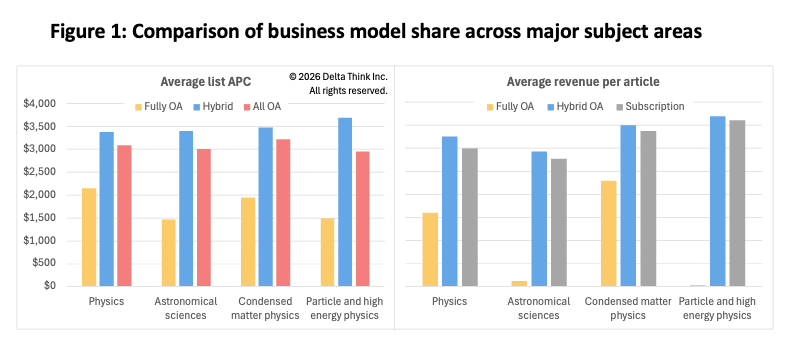
Even within Physics, APC pricing varies considerably. Astronomy and Particle Physics both sit well below the discipline-wide average for fully OA journals, demonstrating that subject-level averages can obscure substantial differences.
The left-hand chart shows average list APC prices. The average across all Physics is shown in left-most set of bars. Three of the nine subjects we track within Physics are shown in the next three sets of bars across the chart. The color variations within each set show how the averages vary by access types.
- Note how APCs for Physics as a whole average just over $2000 for fully OA (gold) journals (left-most, yellow bar). Hyrid APCs average a little under $3500 (2nd-left blue bar). Together (fully and hybrid OA) the average works out at just over $3000 (3rd-right red bar).
- Working left to right across the chart we can see how average APCs vary within Physics, for three sub-disciplines.
- Compared with Physics overall, fully OA APCs are 25% less expensive in Astronomical Sciences. The same is true for Particle and High Energy Physics, which also sees its hybrid APCs average a few percent higher than Physics overall.
- There are significantly more hybrid journals than fully OA ones, so the averages across all OA (red bars, 3rd in each group) closely track hybrid averages. Where there are proportionately higher numbers of less expensive fully OA APCs (e.g. for Particle and High Energy Physics), we see a corresponding greater fall in the overall average prices.
The right-hand chart above estimates the average revenue realized per article. The layout and colors are the same as the chart to the left, except that the gray (right-most) bars in each group look at subscription access.
- Hybrid and subscription revenues per article are strong in all cases.
- For Physics as a whole, fully OA articles generate significantly less revenue than their hybrid and subscription cousins. This is largely a reflection of lower average list prices.
- In some areas average fully OA revenues per article are relatively very low. This reflects a skewing in prices below the average. Where there is high usage of lower-than-average priced journals in a subject, the average realized revenue will drop.
Market value
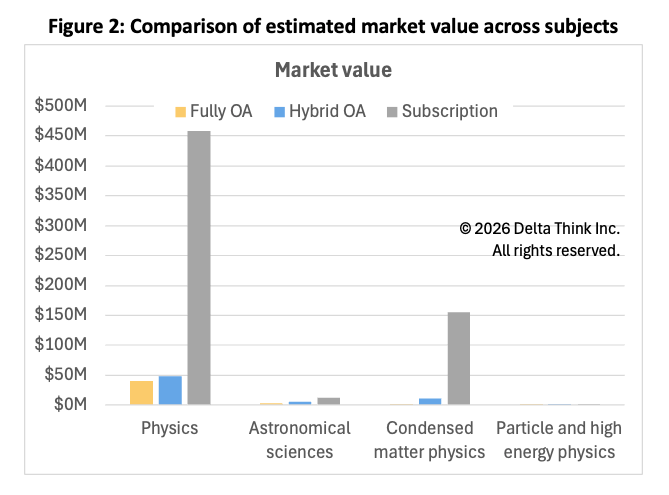
We derive our realized revenues per article from estimates of total market value, shown as follows.
Sources: OpenAlex, The Register for Scientific Journals, Series and Publishers, ANZSRC, Delta Think analysis.
Market value isn't driven by price alone. Publication volume matters just as much, which is why some lower-priced subject areas still represent substantial markets.
The chart above estimates total revenue for Physics and each of the previously explored three subjects within it. However, the relatively tiny share of some revenue means bars are too small to resolve (particularly in Particle and High Energy Physics).
- Here, the number of articles count. Significantly more articles are published under subscription models, which drive the high revenues in Physics overall and in Condensed Matter Physics.
- There are far fewer articles in other subjects and other business models, so our models show much smaller revenues.
- That said, relatively high numbers of articles can still push revenue up. So, fully OA revenue for Astronomical Sciences is just under half that for hybrid OA, even though fully OA revenue per article (as per figure 1) is a much lower proportion.
Conclusion
Publishers and their customers do not systematically publish details of revenues or expenditures. We must therefore use models to estimate the market values, especially to drill into the fine resolutions we are attempting here.
Our models combine two dimensions: volume and pricing. Both have a role to play. Interesting patterns in our modelling suggest there is a multiplier effect between the two. Subject areas with lower prices may see significantly lower estimated revenues depending on their patterns of usage and uptake. Skews underlying list pricing are not reflected in headline averages. A high prevalence of lower-priced journals, or a bias in numbers of articles flowing through them, can drive down realized revenues.
No models are perfect, of course. It’s entirely possible that ours are discounting revenues. Revenues from sponsored (“Diamond”) journals may be understated. Sponsorship, Subscribe to Open, and mixed model (“transformative”) deals may be negotiated by subscription or library sales teams and be classified by participants under subscription income rather than as open access income. The value of deals is largely opaque, and so our proxy measures may not fully account for these factors.
Even allowing for this, subscription revenues remain strong. As our annual market sizing suggests, OA share of market uptake significantly lags its share of market value.
The lesson is straightforward: headline averages rarely tell the full story. Whether you're evaluating publishing strategy, negotiating agreements, or assessing market opportunities, subject-level detail matters. With more than 220 subject areas available in our Data & Analytics Tool, subscribers can move beyond averages and understand the markets most relevant to their organizations. Not a subscriber? Reach out to get started.
---
This article is © 2026 Delta Think, Inc. It is published under a Creative Commons Attribution-NonCommercial 4.0 International License. Please do get in touch if you want to use it in other contexts – we’re usually pretty accommodating.
TOP HEADLINES
ISSN IC and DOAJ: Strengthening collaboration for better scholarly metadata – July 6, 2026
"The ISSN International Centre and the Directory of Open Access Journals (DOAJ) are pleased to announce the signing of a new Memorandum of Understanding, reinforcing our collaboration to improve metadata exchange, interoperability and the visibility of open access scholarly resources."
Wiley and Big Ten Academic Alliance Sign Agreement to Advance Open Scholarship Across Leading U.S. Institutions – July 2, 2026
"Wiley...today announced their agreement to support open access publishing with the Big Ten Academic Alliance (BTAA). The agreement, effective through December 31, 2027, ensures that researchers at participating institutions can publish open access articles in Wiley’s journals—advancing the BTAA’s long-standing commitment to open scholarship."
Open for impact: What China’s OA growth shows about the future of global research – July 2, 2026
"Recent years have seen rapid rise in the number and reach of gold open access (OA) articles from China. A new white paper explores how gold OA publishing is increasing the visibility and reach of China’s research globally, and how this growth benefits China and its international partners, particularly in the Global South."
STM statement on proposed revisions to U.S. federal funding regulations affecting publication and dissemination of federally funded research – June 17, 2026
"STM strongly opposes the Office of Management and Budget (OMB)’s proposed revisions to the Guidance for Federal Financial Assistance. We stand with colleagues across the library, university, and research communities in warning that these provisions will undermine the independent, rigorous system that has made American science the envy of the world."
New report: Phase II of China’s Excellence Action Plan for STM Journals – June 17, 2026
"STM consultants Shuai Yan, Mark Robertson, and Eric Na have published a detailed report on Phase II of China’s Excellence Action Plan — the largest national initiative in Chinese scholarly publishing, now supporting 13 journal cluster pilot projects with 45 million RMB in annual funding."
OA JOURNAL LAUNCHES
Indonesian Academy of Sciences and Taylor & Francis launch open access journal to foster global scientific collaboration - June 23, 2026
"The Indonesian Academy of Sciences (AIPI) and leading international publisher Taylor & Francis have announced a new journal designed to bring together researchers at all career stages, foster collaboration across scientific disciplines, and make translational research available to the policymakers addressing today’s global challenges."