News & Views: Beyond APC Tracking – Helping Libraries Measure Publishing Cost and Impact

Many libraries are discovering that APC management is evolving from operational tracking into institutional analysis of publishing economics to inform strategy development.
To date, APC-related workflows have focused primarily on operational needs: processing payments, tracking compliance, or monitoring publishing activity under institutional agreements. However, the questions libraries are being asked now are increasingly financial and strategic:
- How much are researchers spending to publish?
- Are institutional agreements producing measurable economic value?
- In what subject areas are APC costs rising fastest?
- How do institutional publishing patterns compare with broader market behavior?
- How can libraries better support authors navigating an increasingly complex journal landscape?
Current institutional systems are not designed to answer these questions comprehensively. Publisher dashboards, finance systems, repositories, and bibliometric tools each provide partial visibility, rather than holistic, normalized APC pricing intelligence or longitudinal market context.
As a result, many libraries are beginning to combine internal institutional reporting with external market datasets and benchmarking tools.
APC Spend Is Becoming a Strategic Institutional Metric
APC tracking is often decentralized and incomplete, particularly when payments originate from multiple budgets, departments, grants, or publisher agreements. As OA participation grows and publishing costs and associated models continue to diversify, scaling that approach becomes increasingly difficult.
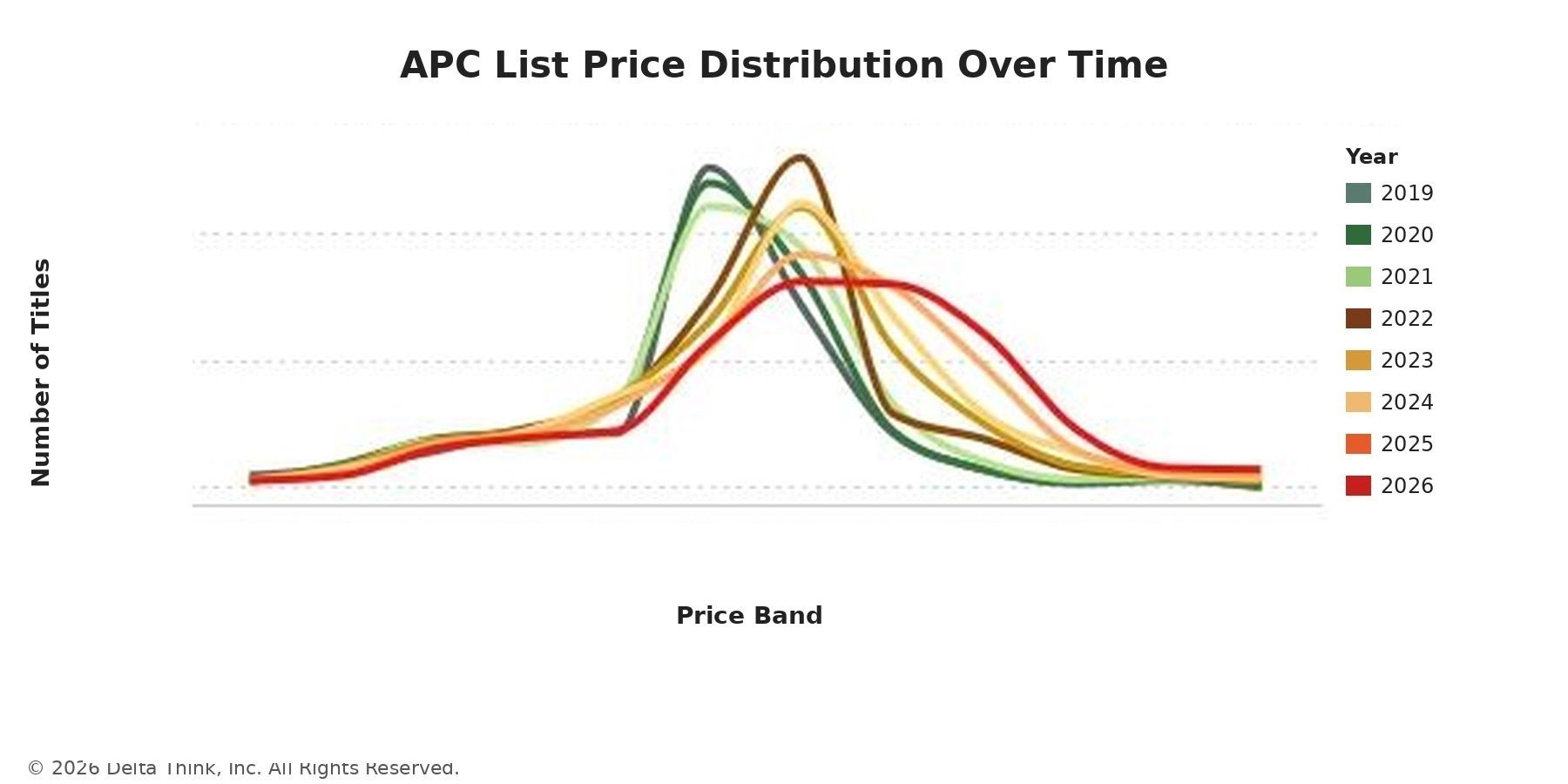
Recent APC market behavior highlights why this analysis matters. While average APCs continue to rise, the more significant trend may be the widening spread of pricing across journal portfolios. In practice, this means institutions can experience meaningful cost increases even when publishing output remains relatively stable.
This is driving greater interest in analyses that move beyond aggregate APC totals to examine:
- Publisher-level APC pricing behavior
- Subject-specific APC pricing and trends over time
- Hybrid versus fully OA pricing dynamics
- Concentration of spend within specific publisher portfolios
- Longitudinal changes in publishing activity and output
Delta Think’s Data & Analytics Tool (DAT) enables libraries to benchmark institutional APC activity against longitudinal market pricing trends across publishers, journals, and disciplines. By normalizing APC pricing data over time, institutions with subscription access to DAT identify cost concentration, track pricing movement, and better understand how local publishing activity compares with broader market behavior. For example, the chart below tracks APC spending and popular price bands from 2019-2026:
“Cost Avoidance” Is Becoming Central to Agreement Evaluation
Another emerging area of focus is the measurement of APC “cost avoidance” (aka “savings”) associated with institutional agreements.
In earlier phases of OA transition discussions, many institutions emphasized publication counts or participation metrics when evaluating agreements. Now libraries and consortia are increasingly being asked to demonstrate the direct financial implications of negotiated publishing rights, discounts, and waivers.
This has led to growing interest in estimating:
- APC savings relative to standard journal pricing
- Publishing volume covered under agreements
- Mitigation of cost exposure through negotiated discounts or caps
- Variability in savings across publishers and disciplines
These analyses depend on access to broader APC benchmarking data. Internal agreement reporting may indicate how many articles were published under a deal, but estimating “avoided” spend requires understanding what those articles would otherwise have cost in the market. DAT’s longitudinal APC pricing intelligence provides libraries and consortia the market data to model estimated APC savings associated with institutional agreements by comparing negotiated publishing activity against prevailing journal and publisher APC pricing. This type of benchmarking can support initial negotiations, renewal discussions, internal reporting, and broader analysis of agreement performance over time.
Researcher Publishing Support Is Expanding Beyond Compliance
Libraries are also playing a growing role in helping researchers navigate publishing decisions, particularly as APC variability within disciplines becomes more pronounced.
Authors are increasingly balancing multiple considerations simultaneously:
- APC affordability
- Funder requirements
- Publication visibility and journal prestige
- Citation and impact indicators
The growing need for libraries to support researchers is creating new interest in library analyses that combine APC pricing with journal-level metrics such as SNIP (Source Normalized Impact Per Paper) and IPP (Impact Per Paper) to provide guidance on the relationship of price versus impact when making decisions about where to publish. The chart below shows a scatter plot comparing APC cost vs. impact for hybrid and fully OA journals, filtered by subject area: Engineering & Technology – Computer Science > Cyber Security. Note that DAT charts are dynamic and can be configured across more than 200 subject areas.
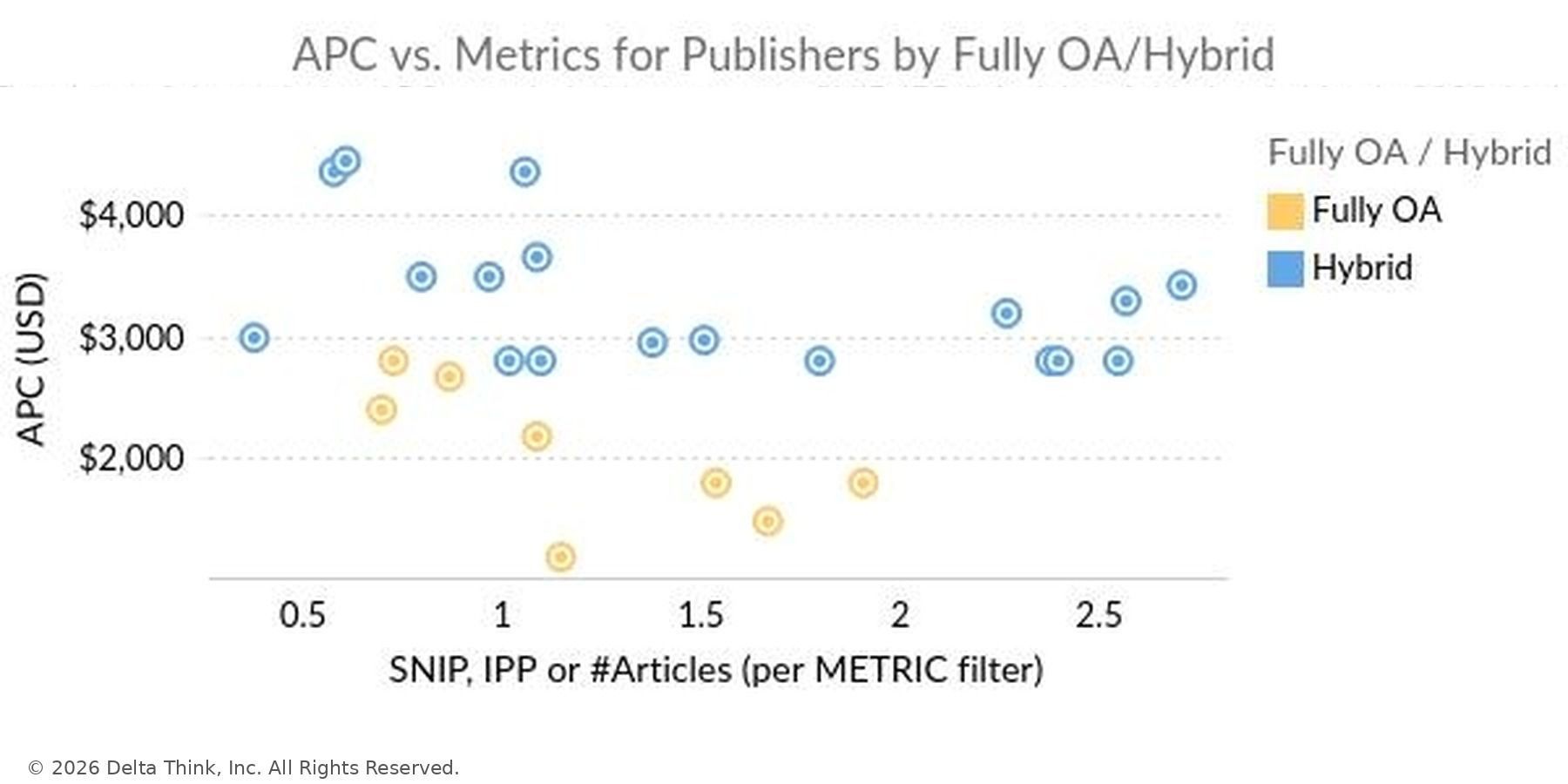
By combining APC pricing data with journal-level metrics and publisher normalization, DAT can support researcher publishing guidance workflows that incorporate both financial and impact-related considerations. Libraries can use this data to help authors compare publishing options across cost, visibility, and disciplinary context.
Supporting Evidence-Informed Open Access Strategy
The broader trend is clear: APC management is gradually shifting beyond operational reporting to include financial and strategic analysis of institutional publishing activity.
Libraries increasingly need access to broader market intelligence that helps contextualize pricing behavior, publisher strategy, and long-term cost exposure across the scholarly communication ecosystem.
Delta Think’s
Data & Analytics Tool (DAT) brings together comprehensive, longitudinal APC data across more than 20,000 journals, helping both sides of the market move from assumptions to evidence-based decisions. Ready to start the conversation?
Get in touch to learn how DAT can support your strategy.
---
This article is © 2026 Delta Think, Inc. It is published under a Creative Commons Attribution-NonCommercial 4.0 International License. Please do get in touch if you want to use it in other contexts – we’re usually pretty accommodating.
TOP HEADLINES
We published in Nature Medicine in 2025 for free. In 2026, it cost us $12,850 – June 11, 2026
"Research findings, especially those produced through taxpayer-funded research, should be available without barriers. Expensive open-access fees pose substantial barriers to making research open to the public."
CFI Invests $4 million to Power Open Science Infrastructure for Canadiana – June 10, 2026
"Universities across Canada are collaborating through the Canadian Research Knowledge Network to drive the evolution of open knowledge with critical open science infrastructure transformation for the Canadiana Collections and Infrastructure."
Why the Gates Foundation Abandoned Article Processing Charges (and What They’re Doing Instead) – June 4, 2026
"In 2024, the Gates Foundation updated their Open Access Policy to redirect funds from APCs to support more equitable models. Ashley Farley explains their thinking and vision for the future."
cOAlition S appoints Curt Rice as Director – May 20, 2026
"cOAlition S is pleased to announce the appointment of Curt Rice as its new Director. With this appointment and the adoption of the 2026–2030 Strategy last November, the coalition moves together to further advance models of open scholarship in the rapidly evolving landscape for scholarly communication."
Theme for Open Access Week 2026 is “The Cost of Knowledge” – May 4, 2026
"'The Cost of Knowledge' is the theme for this year’s International Open Access Week (October 19-25). We create and share knowledge in order to advance human understanding and the common good. We recognize that accessing and sharing knowledge is a human right. Yet, the costs to access and share knowledge continue to increase, often dramatically. Why? Who benefits?"
OA JOURNAL LAUNCHES
Wiley Launches Advanced Brain to Push Disciplinary Boundaries Across Neuroscience & Related Fields – June 9, 2026
"Wiley...today announced the launch of Advanced Brain, an open access, interdisciplinary journal dedicated to publishing cutting-edge research across neuroscience, neurology, psychiatry and psychology. The new journal, part of Wiley’s Advanced Portfolio of high-impact collaborative journals, is now open for submissions."