News & Views: How Open Is “Open” Over Time?

This edition of News & Views looks at the changing patterns of license use over time. Are licenses becoming more or less permissive and what are the implications for scholarly publishers?
Introduction
Last month we compared the patterns of license use as reported by the members of the Open Access Scholarly Publishers Association (OASPA) with those observed in the wider scholarly journals market. Our comparison looked at the aggregated total numbers of licenses during the years 2015-2024. This showed a useful snapshot of the complete 10-year period spanned by the data.
But how has the use of license types changed over that time? This month we dive into the temporal changes, focusing on the core scholarly journals market based on data in our Data and Analytics Tool (DAT). DAT allows for multiple comparisons and in-depth analysis, and, in this edition of News & Views, we highlight a couple of interesting examples of trends over time.
The different types of OA licenses
We start by focusing on only Open Access (OA) journal output. Many funders and institutions mandating OA also insist on certain OA license types, typically more permissive CC0 or CC BY licenses (to be consistent with the foundational Budapest Open Access Initiative). However, more restricted licenses, such as those prohibiting commercial or derivative use, are also broadly used. For the purposes of our analysis, we define these as follows.
- “Permissive” refers to articles published under CC0 or CC BY licenses. These are the ones defined as required by major OA advocates, such as Plan S, Wellcome, HHMI, etc.
- “Restricted” refers to articles published under other licenses that allow limited reuse, such as CC BY-NC (non-commercial), CC BY-ND (no derivatives), or publisher-specific licenses. Although not conforming to the strictest OA mandates, such licenses are widely used and are consistent with many mandated OA requirements. Publishers sometimes charge lower APCs for these more restrictive licenses compared with their permissive counterparts.
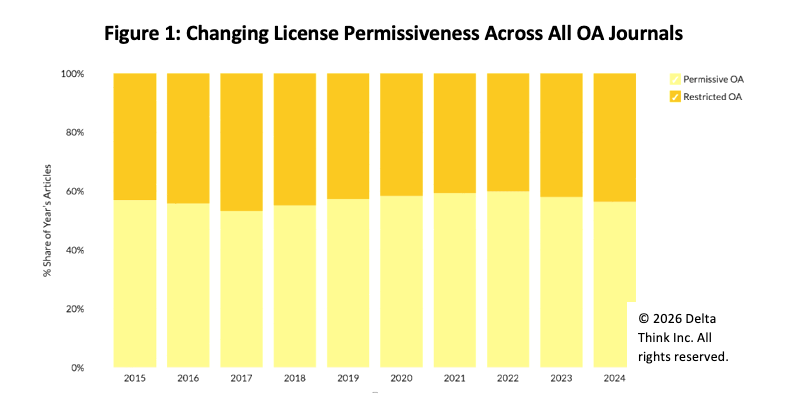
Data comparing the use of permissive vs. restricted licenses in open access output is shown below.
Source: OpenAlex, Delta Think Analysis. © 2026 Delta Think Inc. All rights reserved.
The chart above shows the share of open access articles attributable to our two major OA license types.
- The permissive licenses (bottom half of the bars, light yellow) account for around 55% of OA output.
- The restricted licenses (top half of the bars, darker orange) account for the rest.
The permissive licenses account for a slight majority of OA output with a long-term average of 57%. This has shown signs of a slight decrease in recent years.
Your mileage may vary
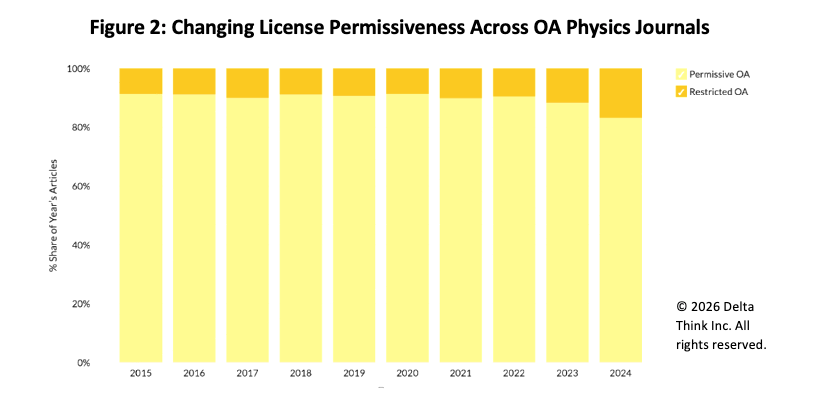
As ever, the market-wide averages mask important nuances, as shown in the following chart.
Source: OASPA, OpenAlex, Delta Think Analysis. © 2026 Delta Think Inc. All rights reserved.
The chart above is the same as the previous one but only includes OA physics journals. We can see a very different pattern, with permissive licenses accounting for more than 90% of share over the long term. This has dropped to just below 85% over the last couple of years. Here we take physics as an example. Subscribers to our Data and Analytics Tool can examine this data for more than 200 subjects.
Other access types
Comparing permissive with restricted licenses provides useful insights for setting and understanding open access policies and activities. Mandates such as Plan S focus on fully open (“gold”) journals. But what about the rest of the market?
Source: OASPA, OpenAlex, Delta Think Analysis. © 2026 Delta Think Inc. All rights reserved.
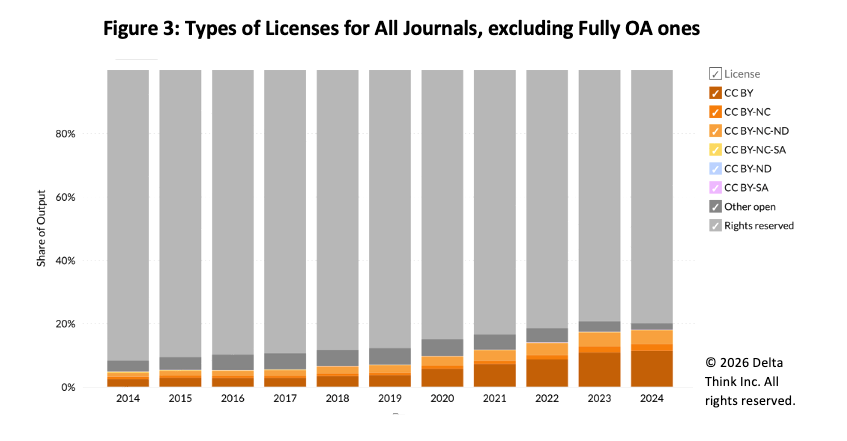
The chart above drills into more details about specific license types, excluding fully OA journals.
- The chart covers only hybrid OA journals and those with no OA options.
- The bulk of licenses used where the OA options in hybrid are exercised are now Creative Commons ones.
- The most common licenses – marked as “Rights reserved” and shown in the dark grey, top most share of each bar – are not open, and typically copyrighted by the publisher. Their share peaked at just over 79% in 2023, with a slight falling back in 2024.
- Although not shown in the chart, if we were to add fully OA journals back into the figures, we could see the Creative Commons share increase to around 40%, Other open to around 10%, and Rights reserved to around 50% in 2024.
Conclusion
As the share of open access has grown over the years, so has the share of open access licenses. However, as our data and analysis shows, there are important patterns to be aware of below the headline information.
First, the dynamics specific to permissive OA licenses (CC BY or CC0) are important as they speak to mandates from large funders who play an important role in driving OA uptake. Funders may take different views on journal format – hybrid vs. fully open – but many insist on licenses consistent with OA’s foundational Budapest Open Access Initiative. By categorizing licenses the way we do, we can easily see how their adoption is changing. We can further see the differences between general averages and specific subjects. Much like open access adoption itself, these differences can be profound.
Second, we can see changing patterns in license usage overall. Publishers have moved away from using their own licenses and now mostly adopt Creative Commons ones. The attribution-only CC BY license is now the most commonly used OA license, although this was not always the case. However, licenses with greater restrictions – such as non-commercial or no derivatives – remain a significant subset of the market. Again, this varies – particularly by journal type.
These patterns have important implications for the costs and revenues of the scholarly publishing ecosystem. Publishers may charge less for these more restrictive licenses, as they are able to extract revenue from sources other than publication fees.
Subscribers to our DAT can explore details further, illuminating how these dynamics apply to their specific situation and organization. Please get in touch to learn more about subscribing or to set up a demonstration.
---
This article is © 2025 Delta Think, Inc. It is published under a Creative Commons Attribution-NonCommercial 4.0 International License. Please do get in touch if you want to use it in other contexts – we’re usually pretty accommodating.
TOP HEADLINES
MDPI Open Access Publishing Agreement with 96 Institutions Across Sweden – February 4, 2026
"We're pleased to announce that MDPI has signed a comprehensive Institutional Open Access Program (IOAP) agreement covering 96 institutions across Sweden. If you are a researcher affiliated with a participating Swedish university, university college, or government research institute, here's what this means for you..."
IReL members supporting Diamond Open Access – February 3, 2026
"Since 2025, IReL has been promoting and coordinating members’ supports for Diamond open access publishing. Diamond open access means OA without any barriers to participation: the content is freely available to anyone to read or reuse, and authors anywhere are free to publish their works without publication charges or needing to be eligible for OA publishing agreements."
EIFL renews agreement with Taylor & Francis – January 26, 2026
"EIFL has renewed an agreement with Taylor & Francis, for three years until 31 December 2028. The agreement includes discounted access to journals and waived and discounted Article Processing Charges (APCs)."
IGI Global Scientific Publishing Launches Flat-Fee Open Access Publishing Agreement – January 14, 2026
"IGI Global Scientific Publishing—dedicated to “Publishing Tomorrow’s Research Today” since 1988, announces the launch of its Flat-Fee Open Access Publishing Agreement, offering a sustainable open access option for libraries and their institutions’ aspiring researchers with unlimited open access publishing."
First 100 path to open books now available open access worldwide on JSTOR – January 12, 2026
"JSTOR, part of the nonprofit ITHAKA, today announced a major milestone for open scholarship: the first 100 books published through Path to Open are now openly available to readers around the world. Originally released in 2023 with early access for Path to Open participating libraries, these titles have officially “flipped” to open access..."
OA JOURNAL LAUNCHES
New Journal Announcement: Circularity in Built Environments - January 19, 2026
"Canadian Science Publishing (CSP) is pleased to announce the launch of Circularity in Built Environments, a new open-access journal set to open for submissions in March 2026."
JAPMA Transitions to Open Access Through New Publishing Partnership with MDPI - January 14, 2026
"The American Podiatric Medical Association (APMA) announced today that the Journal of the American Podiatric Medical Association (JAPMA) will transition to an open-access publishing model through a new partnership with MDPI, effective January 1, 2026."