News & Views: How Open Is “Open”? What OASPA’s License Data Reveals About the OA Market
Overview
This month we look at the changing mix of licenses in use among OASPA members and what these trends reveal for open access publishing more broadly.
Introduction
Each year OASPA surveys its member organizations to gather information about the volumes of output they publish in their fully OA and hybrid journals. These data provide a useful lens on how the most OA-committed publishers are approaching licensing and how that compares with the market as a whole. We’re delighted to be working with OASPA on its survey again this year. We process the raw data into consistent categories, normalize publisher names, and create visualizations of the data over time. We also produce a yearly blog post in cooperation with OASPA, outlining some of their results.
Because space constraints limit what can be covered in OASPA’s own post, we explore additional angles here, placing OASPA member behavior in the context of Delta Think’s wider, market-level analysis. Subscribers to our Data and Analytics Tool can investigate the data further still. Our work with OASPA provides a complementary view into our market-wide analysis.
Use of Licenses
We can examine which common open access licenses are in use, as follows.
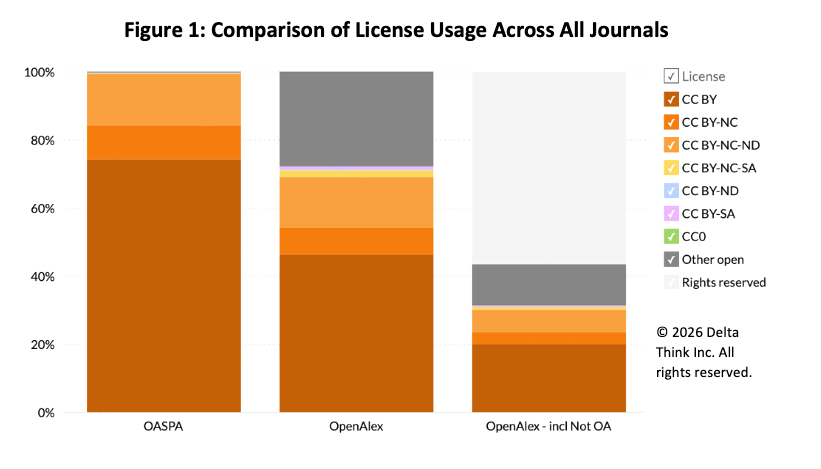
Source: OASPA, OpenAlex, Delta Think Analysis. © 2026 Delta Think Inc. All rights reserved.
The chart above shows the share of articles attributable to various license types, comparing different sources. The left two bars analyze open access articles – for OASPA members on the left and Delta Think estimates for the core market from OpenAlex in the center. The right-most bar adds non-OA content to the OpenAlex figures, for context. The most permissive licenses are at the bottom (CC BY), through to the least permissive at the top, except for the tiny amount of CC0, highlighting how much reuse freedom is actually being granted. The data cover articles published from 2015 to 2024.
- CC BY (Creative Commons, attribution only) is by far the most prevalent form of license in use. It accounts for almost 75% of OASPA output and 46% of OpenAlex OA market output.
- CC BY-NC-ND (which adds non-commercial and non-derivative restrictions), accounts for approximately 15% of output in both cases.
- When non-OA content is included, “all rights reserved” unsurprisingly accounts for a substantial share—reflecting the fact that open access still represents only around half of total output in 2024, as noted in our Annual Market Sizing Update.
When surveying its members, OASPA gathers data on OA license use other than Creative Commons. OpenAlex does likewise in generating its data. We show these as “Other open” in the charts, which accounts for 28% of OpenAlex market output. If we were to remove “Other open, ”OpenAlex’s use of CC BY would drop to 64% of the remaining output, while CC BY NC-ND would rise to 20%. This underscores how sensitive headline figures are to classification choices.
Hybrid is Different
License use looks markedly different once fully OA (“gold”) journals are removed from the analysis.
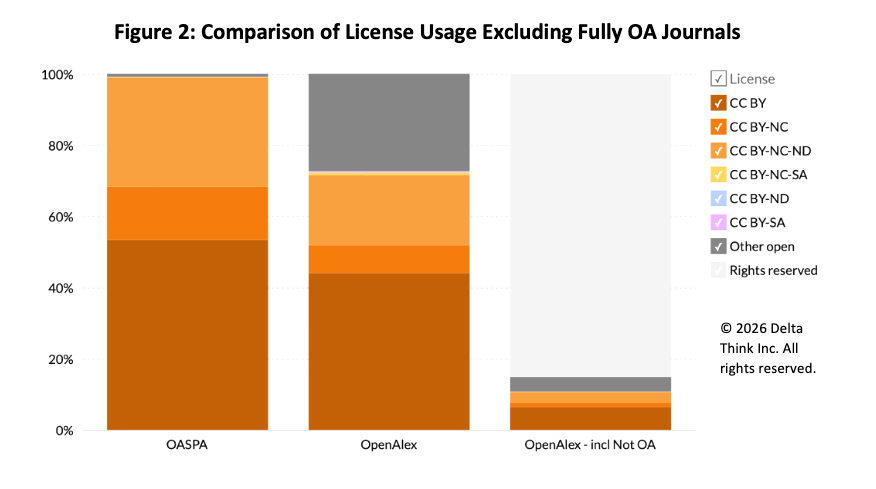
Source: OASPA, OpenAlex, Delta Think Analysis. © 2026 Delta Think Inc. All rights reserved.
The chart above is the same as the previous one but only includes hybrid journals and those with no OA option.
- The use of more restrictive open licenses is much higher.
- CC BY-NC-ND now accounts for more than 30% of OASPA members’ output and 20% of OpenAlex market output (rising to 27% excluding the “Other open” content).
- CC BY has fallen back to around 54% of OASPA output and 44% of OpenAlex output.
- More strikingly, more than 85% of all content outside fully OA journals remains fully rights-reserved, highlighting the relatively modest uptake of OA options in hybrid titles. Our DAT subscribers can explore use of OA in hybrid journals in detail.
Changing Make-up of OASPA Membership
A challenge we met in recent years was some large publishers either joining or leaving OASPA. Could these affect patterns in output and licenses in use by OASPA members?
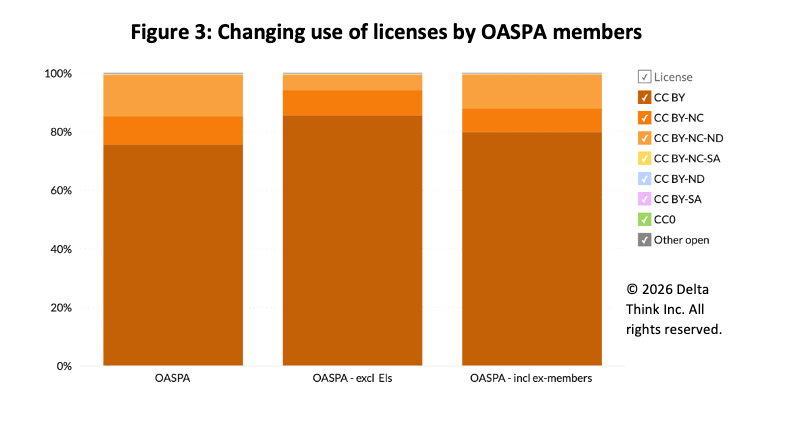
Source: OASPA, OpenAlex, Delta Think Analysis. © 2026 Delta Think Inc. All rights reserved.
The chart above is the same as the first one, except it compares current OASPA members (left – same as the first chart) with an assumptive scenario in which membership had not changed. The changes don’t look significant, but the use of CC BY would have been more prevalent:
- Elsevier joined OASPA in 2022. As Elsevier makes less use of CC BY licenses than the OASPA average, excluding it raises CC BY’s share of OASPA output by around 10 percentage points.
- Springer Nature is no longer a member of OASPA. Because Springer Nature makes slightly greater use of CC BY licenses, adding it back increases CC BY’s share by around 5 percentage points.
These effects are modest but underline an important point: association-level data like OASPA’s can shift due to the members included in the data set and/or due to actual changes in behavior.
Conclusion
Comparisons between OASPA survey data and Delta Think’s market data are not strictly like-for-like as each represents different samples and methods. However, they set a useful context.
We last ran this comparison in 2023. Since that time, CC BY licenses remain by far the most prevalent licenses in use. CC BY share has declined by 5 percentage points since then, but this can largely be attributed to Springer Nature leaving OASPA. On a like for like basis, CC BY continues to be the dominant license in use.
More than 99% of content produced by OASPA members is governed by Creative Commons licenses. Creative Commons accounts for the lion’s share (more than 70%) of the wider market. The “Other open” licenses include government licenses (which may be copyrighted, but with permissive reuse options), public domain licenses, software-style licenses (which allow permissive reuse), or publisher-specific open licenses most commonly used more by smaller publishers (not shown in our charts above).
Space constraints have limited us to looking at total output over the last 10 years or so. We will examine how the use of licenses has changed over time in a future post. Meanwhile, subscribers to our DAT can explore details further, including looking at how permissive (CC BY) licenses compare with restricted ones (such as non-commercial use) when broken out by discipline and by publisher. Please get in touch to learn more about subscribing.
---
This article is © 2025 Delta Think, Inc. It is published under a Creative Commons Attribution-NonCommercial 4.0 International License. Please do get in touch if you want to use it in other contexts – we’re usually pretty accommodating.
TOP HEADLINES
EIFL renews agreement with World Scientific – January 5, 2026
"EIFL has renewed and expanded its agreement with World Scientific for one year, until the end of 2026. The renewed agreement provides waived or discounted Article Processing Charges (APCs) for authors to publish in 145 hybrid or gold (fully) open access journals in various fields."
Jisc secures landmark publishing agreements for UK universities – December 24, 2025
"Jisc today announces the successful conclusion of negotiations, led on behalf of the UK higher education sector, with all five leading academic publishers – Taylor & Francis, Elsevier, Springer Nature, Wiley, and Sage – conducted under its Next Generation Open Access programme."
The Company of Biologists: Read & Publish Open Access agreement with IReL renewed for a further three years – December 18, 2025
"The Company of Biologists is delighted to announce the renewal of its five-journal Read & Publish agreement with IReL. Building on the success of our previous partnerships, we have signed a new agreement that will run from 1 January 2026 to 31 December 2028."
The MIT Press and Open Mind partner with Lyrasis to support diamond open access publishing through the Open Access Community Investment Program – December 11, 2025
"The MIT Press and cognitive science journal Open Mind are excited to announce a partnership with Lyrasis through the Open Access Community Investment Program (OACIP), an innovative model that brings together libraries, scholarly communities, and nonprofit publishers to support diamond open access journals."
OA JOURNAL LAUNCHES
American Physical Society launches APS Open Science to expand global participation in trusted physics research - December 3, 2025
"As the scientific community embraces open science principles, the American Physical Society is launching a new open access journal designed to meet the moment. With submissions opening in late February 2026, APS Open Science will publish a diverse range of research outputs while upholding the trusted, rigorous review processes that define APS standards."