News & Views: Market Sizing Supplement 2025 – Your Mileage May Vary

Overview
Each year, our scholarly market sizing update and analysis goes way beyond open access headlines. One consistent finding is that market share of open and subscription access is highly dependent on subject area. This month we look at how to best use our Delta Think Data and Analytics Tool (DAT) to understand and analyze these variations. With coverage of approximately 220 detailed subject areas, the data shows that headlines can sometimes mask important detail.
Background
Since we began our scholarly journal market analyses in 2017, one of our core objectives has been to enable deep analysis of our headline findings.
Our annual market share updates represent a summing of data – more than 200 detailed subject areas, 200 or so countries, also split by society vs. non-society journal ownership. This level of detail is clearly too much for our monthly short-form analyses, so we present the market-wide headlines in our annual updates.
However, by picking one subject area as an example, we can see how much nuance lies beneath the surface, and why these variations matter. Subscribers to DAT can use our interactive tools to quickly and easily see each level of detail and filter for just those relevant to their organization.
Market Share Variation by Subject Area
Our latest market headlines suggested that open access (OA) accounted for just under 50% of article output in 2024. However, this headline proportion varies considerably by subject area.
Sources: OpenAlex, The Register for Scientific Journals, Series and Publishers, ANZSRC, Delta Think analysis.
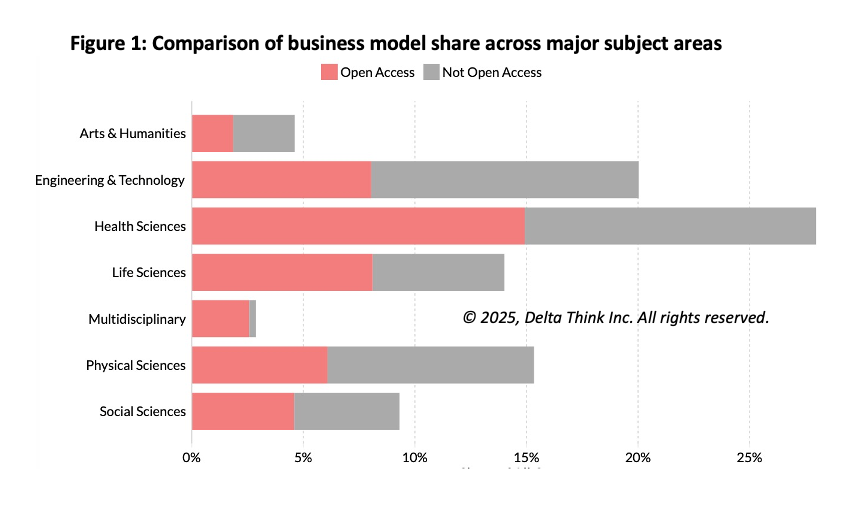
The chart above compares share or total output and share of access types for major subject areas.
- It shows one bar for each major subject area across our sample of total monetizable scholarly journal output.
- The total length of each bar is proportional to the subject area’s share of all output. So, for example, Engineering & Technology accounted for 20% of global output in our sample.1
- The coloring of the bar shows the proportions of open access within each subject area (pink, left-hand side) with non-open access (grey, right-hand side).
We can see that prevalence of open access is dependent on subject area. For example, open access comprises around 90% of Multidisciplinary journal output, but 40% of Physical Sciences output. However, Multidisciplinary journals account for a small proportion of total output (around 3%). There are five times more articles published in Physical Sciences, so its footprint has far more impact in the overall market.
The Devil is in the Detail
Further, DAT can break broad-brushstroke subject areas to fields to illuminate detail including the business models and variations within them. The figure below shows one such example.
Sources: OpenAlex, The Register for Scientific Journals, Series and Publishers, ANZSRC, Delta Think analysis.
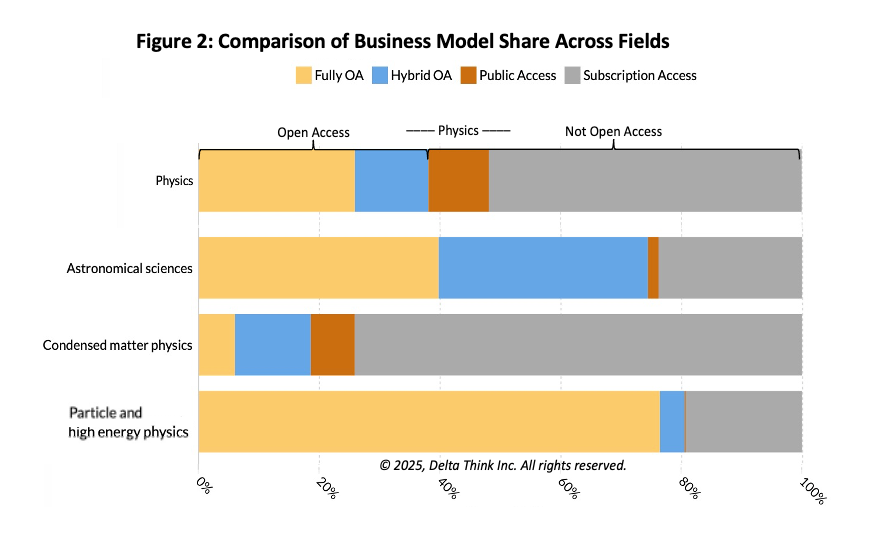
The chart above drills into one part of the Physical Sciences: Physics, which is shown in the top bar. (In our taxonomy, Physical Sciences also includes Chemistry, Earth Sciences, and Mathematics.) Physics in turn has several subjects within it, including the three bars in the rest of the chart. The color variations show the share of output attributable to access types for each subject.
- Output in fully OA (gold) journals is shown in yellow (left-most), then OA output in hybrid journals in blue (second from left). Together these add up to total open access output (comparable to the pink, left-hand proportions of the bars in Figure 1 above).
- Output that is public access – free of charge to read but not to reuse – is shown in brown (second from right portions of the bars). Articles requiring a subscription to access are shown in gray (right-most). Together these add up to the non-open access output (comparable to the gray, right-hand proportions of the bars in figure 1.
So, what we see here is how appetites for different types of access compare between different subjects. Across the whole of Physics, open access comprises just under 40% of output (yellow + blue proportions).
However, when we drill into the different subsets of Physics, we see different patterns emerge.
- Astronomical Sciences has a much higher appetite for open access, which makes up around 75% of its output, split roughly equally between fully OA (gold) journals and hybrid open access.
- Compare and contrast this with Condensed Matter Physics, where OA makes up just 20% of its output, split roughly one third fully OA to two thirds hybrid OA. Most output here (around 70%) is via subscription access.
- Like Astronomical Sciences, Particle and High Energy Physics shows a high appetite for OA. But more than 90% is in fully OA journals, compared with the roughly equal split in Astronomical Sciences.
Conclusion
Variations between disciplines are probably not news to stakeholders in the scholarly journals ecosystem. However, the level of variation – even within closely related disciplines – certainly warrants attention.
The analysis shows two important dimensions: First is the uptake or use of difference access types. This indicates the likely appetite for different business models depending on discipline and subject area. There are clear and sometimes significant variations between disciplines, and a specialty publisher or librarian should be aware of these when making plans, from editorial to collection management strategy and budgeting. However, variations within subjects in each discipline are even more marked. So even for a speciality operator, one size cannot fit all. There may be compelling cases for subscription journals in some instances and equally compelling cases for open access journals in others.
Secondly, scale is important. If a discipline produces only small proportions of overall output, then its appetite for one business model over another will make little or modest differences as part of a bigger whole. This can be an important guide to setting priorities.
It’s not possible to show the depth and diversity of this data in a thousand-word blog post, so we chose one subject area, field, and subjects as an example. But the principles behind this analysis apply across the board. With around 220 subjects in our data set, DAT offers key insights and actionable levels of detail. Subscribers to the Data and Analytics Tool have access to the full data set and analysis, combined with tools to dig deeper into specific subject areas, publishers, models, and more. Not a subscriber? Please reach out to get started.
---
1 The chart analyses article numbers, but we classify them by the subjects of their parent journals. Around 5.7% of the 77,251 journals in our sample have no subject information. For clarify, these “Unclassified” journals are not shown on the chart, so total bar lengths will add up to 93.3%.
---
This article is © 2025 Delta Think, Inc. It is published under a Creative Commons Attribution-NonCommercial 4.0 International License. Please do get in touch if you want to use it in other contexts – we’re usually pretty accommodating.
TOP HEADLINES
Diamond Open Access on the rise in the U.S., thanks to Gates Foundation grant – November 26, 2025
"A $206,886 grant from the Gates Foundation awarded to Lyrasis, in collaboration with the Big Ten Academic Alliance’s Center for Library Programs and the California Digital Library (CDL), will support the new project Mapping U.S. Diamond Open Access Journals — an initiative to advance community-governed scholarly publishing in the United States."
Big Ten Open Books: An Interview with Kate McCready (BTAA) and Charles Watkinson (UM) – November 20, 2025
"One of the most exciting initiatives working on OA for backlist books is the Big Ten Open Books program. This post is based on a set of questions we posed to Kate McCready (Program Director for Open Publishing, Center for Library Programs at the Big Ten Academic Alliance) and Charles Watkinson (Director of University of Michigan Press and Associate University Librarian for Publishing at the University of Michigan) about what the program is and how it works."
cOAlition S reinforces Open Access commitment while advancing next strategic phase – November 19, 2025
"cOAlition S today reaffirmed its commitment to the foundational mission of accelerating full and immediate Open Access while expanding its vision to encompass the broader goal of rapid, open, transparent, and equitable sharing of trustworthy scientific knowledge. Seven years after the launch of Plan S, the international coalition of research funding and support organisations has defined a new strategic plan to advance their joint efforts on open access forward (2026-2030)."
Elsevier Expands Geographical Pricing for Open Access to support greater participation in global research – October 22, 2025
"Elsevier, a global leader in advanced information and decision support in science and healthcare, is expanding its Geographical Pricing for Open Access (GPOA) initiative to an additional 150 gold open access journals, following the success of its 2024 pilot. This expansion means around 300 journals will offer pricing based on geography to help authors in low- and middle-income countries publish their research open access."
OA JOURNAL LAUNCHES
ASBMB launches Insights in Biochemistry and Molecular Biology – November 20, 2025
"The American Society for Biochemistry and Molecular Biology is expanding ways to share emerging research across the breadth of the molecular life sciences by adding Insights in Biochemistry and Molecular Biology, or IBMB, to its family of journals...Like all ASBMB journals, IBMB will be gold open access."
American Physical Society to launch new open access journal on AI and machine learning in scientific research – November 19, 2025
"The American Physical Society is launching PRX Intelligence, a highly selective open access journal that will welcome manuscripts on AI and machine learning methods and their application to advance scientific understanding. The journal will accept submissions starting in February 2026."
PLOS launches two journals to address critical real-world challenges – November 13, 2025
"The Public Library of Science (PLOS) today announced the launch of two journals, PLOS Aging and Health and PLOS Ecosystems. Both journals are grounded in our commitment to rigor and research integrity of the highest standard and our open science principles..."
AIP Publishing Announces New Journal Partnership with Hebei University of Technology: Harmonics and Scattering to Launch in 2026 – November 10, 2025
"AIP Publishing (AIPP) is pleased to announce a new publishing partnership with Hebei University of Technology to develop Harmonics and Scattering (HAS), an international, peer-reviewed diamond open access journal dedicated to advancing cutting-edge research in harmonics and scattering technologies."