News & Views: Price Caps and Publishing – The NIH’s Potential Market Disruption

Overview
The US National Institutes of Health (NIH) has proposed caps on allowable publication costs, including article publishing charges (APCs) for NIH-funded research. Given the NIH’s scale, how might this policy affect the scholarly publishing market? Could publishers lose revenue? Could funders save costs? What is the potential net economic impact on the research and scholarly ecosystem?
Background
In summer 2025, the NIH announced an intent to establish new policies limiting allowable publication costs levied against papers arising from NIH-funded research and invited feedback to its proposals. The recently published responses naturally attracted some attention and engagement from a diverse group of stakeholders.
The NIH proposed five options, among them disallowing all publication costs, price caps per publication, and limiting publication costs to a fixed percentage of the research grant’s direct costs.
The NIH’s proposal cited some research into average publication costs. The analysis looked at journal APCs as listed in the Directory of Open Access Journals (DOAJ), averaging from $1,236 to $2,177. It also analyzed budget requests from its grants, with costs per publication averaging between $2,565 and $3,647.
For publishers, these proposals are about more than compliance, it’s about understanding revenue risk, pressure points across portfolios, and where pricing strategies may need to adapt. For libraries, consortia, and funders, it’s about anticipating shifts in spend, benchmarking agreements, and planning for sustainable access models in a constrained environment.
Our analysis
What effects might the proposals have on total prices paid if implemented? To examine this, we combined data from our Data & Analytics tool with numbers from the NIH’s proposed caps.
We also needed to handle a couple of nuances in the NIH’s analysis:
- The DOAJ lists only fully open access (“gold”) journals. However, under current NIH policy, authors may also publish in hybrid journals1. Fully open APCs are typically less expensive than hybrid ones, so we need to include both in our analysis.
- Quantifying the proposal for a fixed 0.8% of grants’ direct costs presents a challenge as the the figures for these are not published. We estimated the applicable costs by combining figures from NIH reports and statements2.
Results
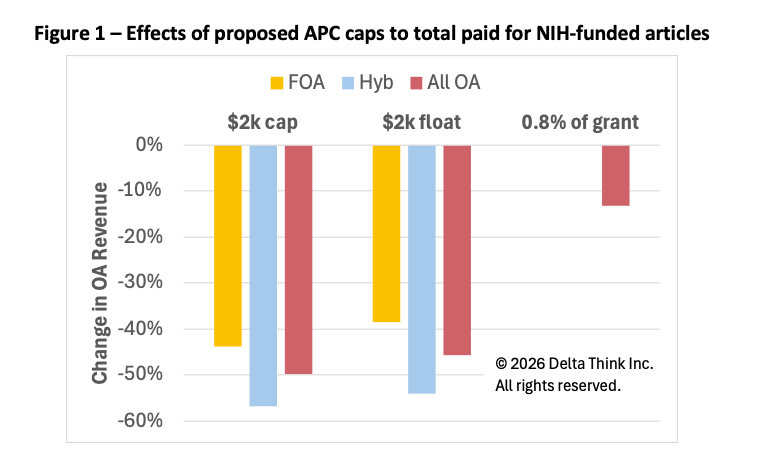
We took the current APCs multiplied by corresponding volumes of articles as a baseline, allowing for typical discounting that we have observed. We then calculated the change from the baseline for some of the NIH’s proposed options noted above. The results are shown in the chart below.
Sources: NIH, Delta Think DAT, Delta Think analysis.
The chart above shows the estimated changes to total spending on APCs for NIH-funded articles only. It shows the variation between “business as usual” and the effects of the following policies:
- $2k cap: APCs can go no higher than $2,000, but less expensive ones remain as is.
- $2k float: all APCs are set to the $2,000 cap. This reflects an unwanted side-effect of price caps, whereby prices below the cap are increased (“float”) to the cap. This is used by vendors to offset losses due to the reduction to prices above the cap.
- 0.8% of grant: total APC spending is set to 0.8% of estimated applicable grant funding.
The scenarios show a fall in spending in all cases:
- The price caps suggest significant falls in spending on APCs – more than 40% for fully open (“gold”) journals (yellow bars, leftmost of each group), and more than 55% for hybrid journals (blue bars, center of each group). The combined total (red, rightmost bars) shows effects lying roughtly mid-way. (The underlying data suggest around 60% of NIH-funded OA articles are published in fully open journals, but at lower average APCs than for hybrid.) The larger impact to hybrid reflects their higher baseline APCs, making them more exposed to caps.
- If publishers set all APCs to the caps (the $2k float scenario; center group of bars), the effects are slightly reduced, but show little difference.
- For 0.8% of grant spending, we cannot differentiate between the use of fully open and hybrid journals, as the number applies to headline grant spending. So we only show the combined effects (right-most bar). The falls in costs are much less – under one third of the effects of the two price-contrained scenarios. This tells us that direct price regulation is potentially far more disruptive than indirect (budget-based) controls.
Sources: NIH, Delta Think DAT, Delta Think analysis.
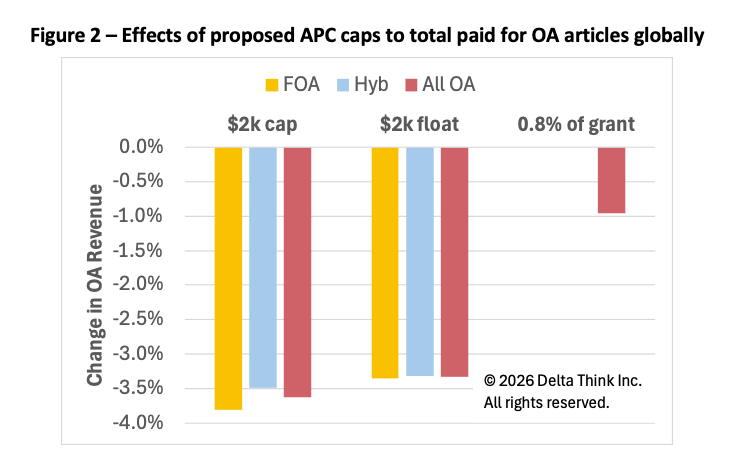
We have previously noted that the NIH accounts for a significant share of global scholarly publishing output. The chart above overlays the changes to NIH spending from Figure 1 onto the global scholarly open access journals market. We assume only the patterns in spending on NIH-funded papers have changed, with all other spending on APCs remaining the same.
- The chart follows the same pattern as the previous one.
- As before, the price-constrained scenarios show the largest fall in spending, at around a 3.5% reduction depending on the exact scenario.
- Spending on hybrid OA is affected less than fully open, the opposite to the NIH-only analysis.
- Again, fixed to the share of grant is just under one third of the price-constrained scenarios.
Conclusion
Our models suggest that the NIH’s proposed price caps could lead to a significant reduction in spending on publication fees for the articles arising from its research. This is unsurprising as the caps are lower than average list prices.
That said, we were surprised about the effects on fully open journals. When we looked at the underlying data (not charted above), the NIH’s proposed caps are just a few percentage points below average list APCs, allowing for typical discounting. However when projected onto the actual journals used, the drop in fully open spending was stark. This likely reflects the choice of more expensive (and more prestigious) journals by NIH-funded authors. The fall in hybrid spending was less surprising, given that hybrid APCs are much higher.
All of this translates to a measurable effect on the global scholarly open access publishing market; again, not surprising given the NIH’s scale. To put the effects in context, a 3.5% reduction in spending due to the effects of NIH cuts compares with a 6.8% growth in the OA market. So, this constitutes around a halving in growth. When constraining to a fixed share of research grants, the gap narrows to around a 1% fall in global OA spending. Low single-digit changes may seem modest; however, the bottom line is that NIH policy alone is sufficient to meaningfully decelerate global OA market growth, especially when compounded with proposed funding cuts.
As always, things may be different depending on an organization’s focus and specialty. Get in touch to see what the data says for your portfolio.
---
1 The dominant factor appears to be compliance with the NIH’s public access policy and retention of rights – although the details may be somewhat confusing where publishers do not allow immediate public access.
2 The applicable R01-equivalent grant values are pulled from the NIH Data Book. We estimate the average share of direct costs based on the NIH’s Supplemental Guidance to infer the denominator for the 0.8% share. We do not model the $20k minimum or any caps in individual APCs.
---
This article is © 2026 Delta Think, Inc. It is published under a Creative Commons Attribution-NonCommercial 4.0 International License. Please do get in touch if you want to use it in other contexts – we’re usually pretty accommodating.
TOP HEADLINES
"Our analysis reveals that 40% of recent articles in the subscription and hybrid (not fully Open Access) journals of the top five publishers are freely accessible online. Although just 26% are designated OA on publishers' sites, an additional 14% can be readily found elsewhere."
CAUL announces major milestone for Open Access: 100,000 articles published and $500 million saved through CAUL Consortium Open Access agreements – April 20, 2026
"Today, CAUL announces an important milestone in Open Access publishing for Australia and Aotearoa New Zealand. Last week, the 100,000th Open Access article was published through a CAUL consortium agreement. CAUL first established Open Access agreements with two small publishers in 2020 and has since grown to include 26 publishers, ranging from small society publishers to the world’s largest academic platforms."
Charting the US Landscape for Open Access Books – April 15, 2026
"...This response considers each of the high-level PALOMERA recommendations from a US perspective. Where do things currently stand for OA book policies? How difficult would implementation be? Who should take the lead? We offer a starting point here for considering these questions and invite stakeholders from across the US scholarly communications ecosystem to further inform these observations..."
SPARC – Launch of the AEGIS-OA Project – April 8, 2026
"We are proud to announce the launch of AEGIS-OA, a two-year project funded by the European Commission under the Horizon Europe call 'Enhancing the European R&I system.' This initiative aims to build a high-quality, non-profit scholarly publishing ecosystem by expanding the European Diamond Capacity Hub (EDCH) to include books and instrumentalising the Diamond Open Access Standard (DOAS)."
International partners launch OA Forward to strengthen Open Access negotiations and advance open scholarly communication – April 8, 2026
"DEAL Open Access Services (DEAS), together with contributing partners...today announced the establishment of OA Forward—an internationally governed coordination initiative that builds on the achievements of the OA2020 movement to advance the next stage of open scholarly communication through coordinated engagement with publishers and other stakeholders."
OA JOURNAL LAUNCHES
Royal Society Publishing achieves the ambitious goal of becoming 100% open access by 2026 – April 15, 2026
"Introducing Subscribe to Open (S2O) has enabled us to achieve our 100% open access target by converting our subscription journals to open access for 2026. This means that there are no charges for readers and researchers can publish open access in the Royal Society’s eight S2O journals without having to pay an article processing charge (APC)."
124 De Gruyter Brill journals publishing open access in 2026 via Subscribe to Open – April 15, 2026
"De Gruyter Brill confirms that all 124 journals in its Subscribe to Open program, DG2O, publish open access in 2026. Following the annual evaluation, every participating title met its renewal threshold, marking the sixth consecutive year in which the entire program has opened successfully."