News & Views: Open Access Charges – When “On Trend” Still Means Higher Spend

This month we examine our latest data about Article Processing Charges (APCs). Per article pricing is a fundamental building block for all paid publishing models, so our review provides an invaluable insight into how the cost of open access continues to evolve. APC prices in general continue to increase, but at a slower rate compared with this time last year. Important nuances in the distribution of prices continue to affect the value and cost of paid publishing models.
Background
Each year we survey the list price Article Processing Charges of a sample of more than 40 scholarly publishers. Our dataset covers more than 20,000 titles dating back to 2016 and represents one of the most comprehensive reviews of open access pricing.
To compare like for like, we consistently analyze non-discounted, CC BY APCs. We take a snapshot annually in January, so we can track yearly changes while controlling for publisher price changes throughout the calendar year. Our statistics here exclude zero or unspecified APCs, although these are present in our underlying data (and available to our subscribers). This allows us to capture trends where publishers choose to charge APCs without skewing averages. We run separate analyses around APC-free models.
Headline Changes
Going into 2026, we see APC prices increasing, but the percentage increases continue to fall back to track long-term trends.
- Fully OA APC list prices across our sample have risen by around 6.8% compared with 6.4% this time last year.
- Hybrid APC list prices have risen by an average of 5.3% compared with 3% this time last year.
- Maximum APCs for fully OA journals remain at $8,900.
- Maximum APCs for hybrid journals now top out at $12,850 (up $160 from last year).
- Average APC prices have increased more this year than last year. However, the increases remain lower than the highs of a couple of years ago.
Underlying trends continue.
- Average APC price increases are getting larger each year.
- There are approximately 2.4x more hybrid journals than fully OA ones, down from 2.6x last year, and 2.9x a year before that. The proportion of journals that are hybrid is slowly falling. However, because they are the majority, hybrid journals follow (or, rather, set) a similar pattern to the market overall.
- On average, fully OA prices are around 67% of those of hybrids – consistent with long-term trends.
- Around 24% of our sample of fully OA journals charge no APCs, compared with 22% last year. (We have separately analyzed the number of articles in OA journals.)
- Price increases vary significantly by discipline. Fully OA Arts and Humanities journals saw larger than average increases; Multidisciplinary journals saw lower than average increases.
Price Distribution
Market-wide headline price changes mask important nuances. We have discussed previously that the most important nuance lies in the spread of prices within a given publisher’s portfolio. For example, if the bulk of a publisher’s journals lie towards the lower end of its APC pricing, with just a few journals priced at the higher end, the average (mean) price will be higher than most authors pay.
The following figures show how the spread of APC prices plays out in the market across our sample of publishers. The figures are outlines of histograms, showing how many titles sit in various price bands over the successive years of data we have curated. The red line shows the most recent year’s prices. The lines become more green as they go further back in time. Subscribers to Delta Think’s Data & Analytics Tool can see full details of the Number of Titles and Price Band axes.
Hybrid Prices
The spread of price bands for hybrid journals is shown in Figure 1 below.
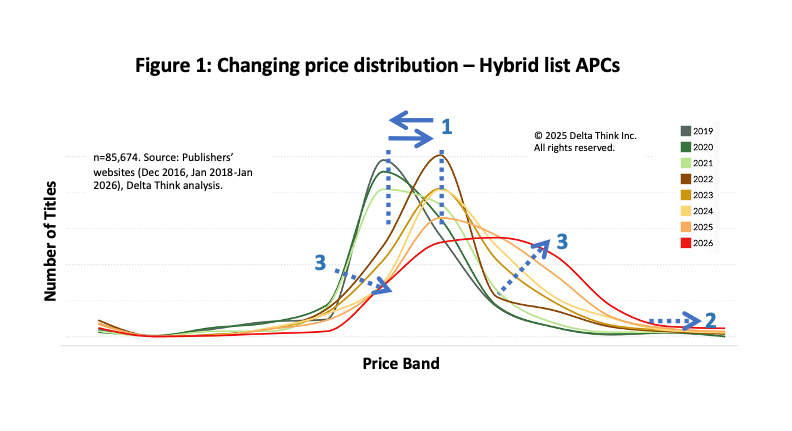
The overall spread of prices has remained relatively constant over time.
- In 2019, the most popular price band shifted slightly towards the lower end of the market and remained there for a few years. However, in 2022 it moved back up to its historic high and has remained there since.
- The steepest price increases occurred in 2020-21, when high-impact journals began offering hybrid options. For clarity, the chart combines the very highest APCs into one band on the right-hand side.
- Average prices paid are heavily influenced by the shape of the curves on either side of the peak. Notice how the curve on the right side of the peak is becoming shallower and wider over time. This suggests that increasing numbers of journals are priced higher than average, and so average prices paid will increase. The curve to the left of the peak was getting shallower, but it is now getting steeper. Thus, the moderating influence of lower-priced journals is now reducing. As the curve widens, the peak reduces to keep the area under the curve roughly the same. This reflects the relatively small change in the total number of journals compared with previous years. We are therefore seeing a movement in price bands of existing journals to increase average prices paid, as higher APCs are becoming more prevalent.
Fully OA Price
The fully OA landscape is shown in Figure 2.
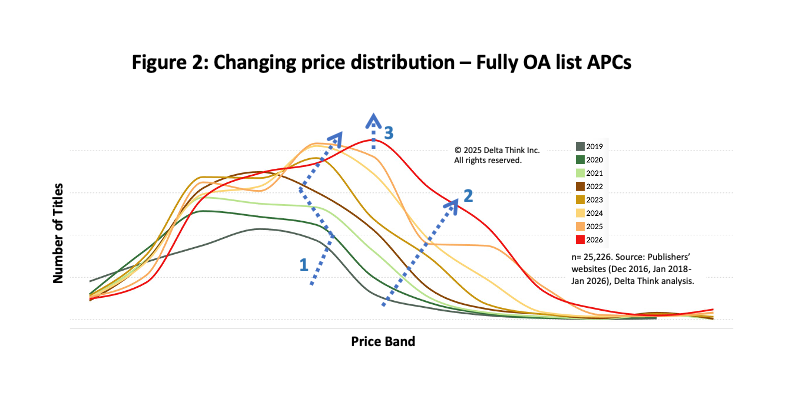
The data suggest that both the number of fully OA journals and their average APC prices continue to increase.
- The peak of the curve is getting higher and moving to the right, so we are seeing an increase in the most popular price band and in average prices. In earlier years, the secondary peak suggested the presence of a significant number of journals cheaper than the most popular price band, which moderated the increase in average prices. In more recent years, the secondary peak moved to the right as prices increased and more expensive journals became more common.
- As with hybrids, average prices paid are heavily influenced by the shape of the curves on either side of the peak. Notice how the curve on the right side of the peak is becoming shallower and wider over time. This suggests that increasing numbers of journals are priced higher than average, and so average prices paid will increase.
- The height of the curve has also increased, illustrating that we are seeing an increase in the total number of fully OA journals. This is due to a mix of more journals being launched or acquired, hybrid journals being switched to fully OA, and increasing numbers of journals falling under “Subscribe to Open” arrangements.
Conclusion
Last year we noted that annual price increases fell back towards long-term trends after the previous year’s large increases driven by a high-inflation environment. Going into 2026, prices increased more than the previous year. However, they remain on trend, as the trend appears to be one of growing price increases.
While outlying price changes are important general indicators, they do not necessarily shift the market on their own. Changes in the spread and emphasis of popular price bands play key roles too. The growing proportion of higher-priced journals continues to increase the average APC prices actually paid.
As we explored at length in our analysis “APC Price Changes – When does up mean down?”, average headline price increases can lead to falling overall spend or vice versa, depending on the numbers of papers published and the spread of price increases across a publisher’s portfolio.
One moderating influence is the high number of journals – usually fully OA titles – that don’t charge APCs. We have not analyzed these here, as we want to focus on patterns in APCs actually levied. Fully OA journals that do not charge APCs are typically funded by some other means: This may be a form of sponsorship or, increasingly, the use of “Subscribe to Open” arrangements.
Per-paper APC information is useful in a wider context too. Even where deals are calculated based on bundles, they are often set by discounting from list APCs – especially where publication activity exceeds agreed caps. It is likely that the high number of journals with no APCs may have their sponsorship prices set based on the per-paper revenues desired. Similarly, understanding revenues generated per paper is important to calculate thresholds for journal flips or for launching and sustaining a "Subscribe to Open" model.
APC pricing in 2026 continues to trend upward, but the more important story lies in how prices are shifting across portfolios—reshaping the real cost of publishing in ways that averages alone can’t capture. As higher-priced journals become more prevalent and pricing distribution widens, understanding the full market context is critical.
For libraries and consortia, this means gaining the insight needed to benchmark spend, evaluate agreements, and plan sustainable open access strategies. For publishers, it means positioning portfolios competitively, testing pricing strategies, and understanding where opportunities—and risks—are emerging.
Delta Think’s Data & Analytics Tool (DAT) brings together comprehensive, longitudinal APC data across more than 20,000 journals, helping both sides of the market move from assumptions to evidence-based decisions. Get in touch to learn how DAT can support your strategy.
---
This article is © 2026 Delta Think, Inc. It is published under a Creative Commons Attribution-NonCommercial 4.0 International License. Please do get in touch if you want to use it in other contexts – we’re usually pretty accommodating.
TOP HEADLINES
SPARC Europe: Launch of the AEGIS-OA Project – April 1, 2026
"We are proud to announce the launch of AEGIS-OA, a two-year project funded by the European Commission under the Horizon Europe call 'Enhancing the European R&I system.' This initiative aims to build a high-quality, non-profit scholarly publishing ecosystem by expanding the European Diamond Capacity Hub (EDCH) to include books and instrumentalising the Diamond Open Access Standard (DOAS)."
British Academy urges national long-form OA strategy – March 31, 2026
"The UK’s national academy for the humanities and social sciences, the British Academy, has called for a joined-up strategy, a sustainable financial model and meaningful engagement with authors when it comes to developing long-form open access (OA)."
EMS Press announces Launch to Open – a transparent new approach to open access – March 29, 2026
"EMS Press is introducing Launch to Open (L2O), a new model designed to help established journals move toward open access with clear costs, shared responsibility and community support. Like other community-based open access models, L2O distributes responsibility across subscribing institutions. What distinguishes L2O is its financial transparency; disclosing the full costs, targets and allocation of subscription revenue for each title."
CERN to host next phase of Open Research Europe platform – March 27, 2026
"CERN has been selected to host a new phase of Open Research Europe (ORE), an initiative supported by the European Commission and a new funding consortium of European national funding agencies and research organisations. Aligned with the Action Plan for Diamond Open Access (2022), the initiative is positioned as a community-led alternative to traditional academic publishing."
All the Seats at the Table: A Summary and Status Review of the NIH APC Caps Proposal – March 20, 2026
"In July 2025, the National Institutes of Health (NIH) proposed to implement caps on the amount of grant funding that can be allotted to article processing charges (APCs), the fees some publishers levy to license articles as freely accessible...The proposal added to the turbulence and uncertainty of the academic and scientific community surrounding open access (OA) publishing."
OA JOURNAL LAUNCHES
10 APS Journals Open Access in 2026 Through Subscribe to Open – March 20, 2026
"The American Physiological Society (APS) has achieved its Subscribe to Open (S2O) goal in 2026, making 10 of its primary research journals open to readers worldwide with no article processing charges (APCs) for authors."
Pensoft launches a new diamond open-access journal: Advances in Pollinator Research – February 20, 2026
"In collaboration with the European Union pollinator projects community...Pensoft launched Advances in Pollinator Research, a new multidisciplinary, community-driven peer-reviewed journal set to transform how pollinator science is shared and translated into real-world action."