News & Views: Market Sizing Update 2026

Dan Pollock and Ann Michael • November 9, 2026

Market Sizing Update 2026
Back on trend: OA lifts market growth, AI is a wild card

Overview


Each year, Delta Think's Market Sizing estimates the value of the scholarly journals market and its open access (OA) segment, the revenue generated by providers, or the costs incurred by buyers of content and services.


The market is opaque, so our analysis combines known data and estimation methodology. This year we updated our method to keep pace with the changing dynamics in the market. We changed how we determine the monetizable market, so we now use a different sample of journals to previous years. The underlying data we use for our analysis has also changed. We have restated prior years so that all comparisons are like for like. A summary of the changes follows this update.


Our updated analysis shows OA value growing faster, and accounting for a larger share of a smaller total market than we previously estimated. OA is the key driver of growth for the market overall. There is some additional upside from AI deals, but it is too soon to infer any underlying trends in AI from our data.


Headline findings


Our models suggest the following headlines for the monetizable scholarly journals market.
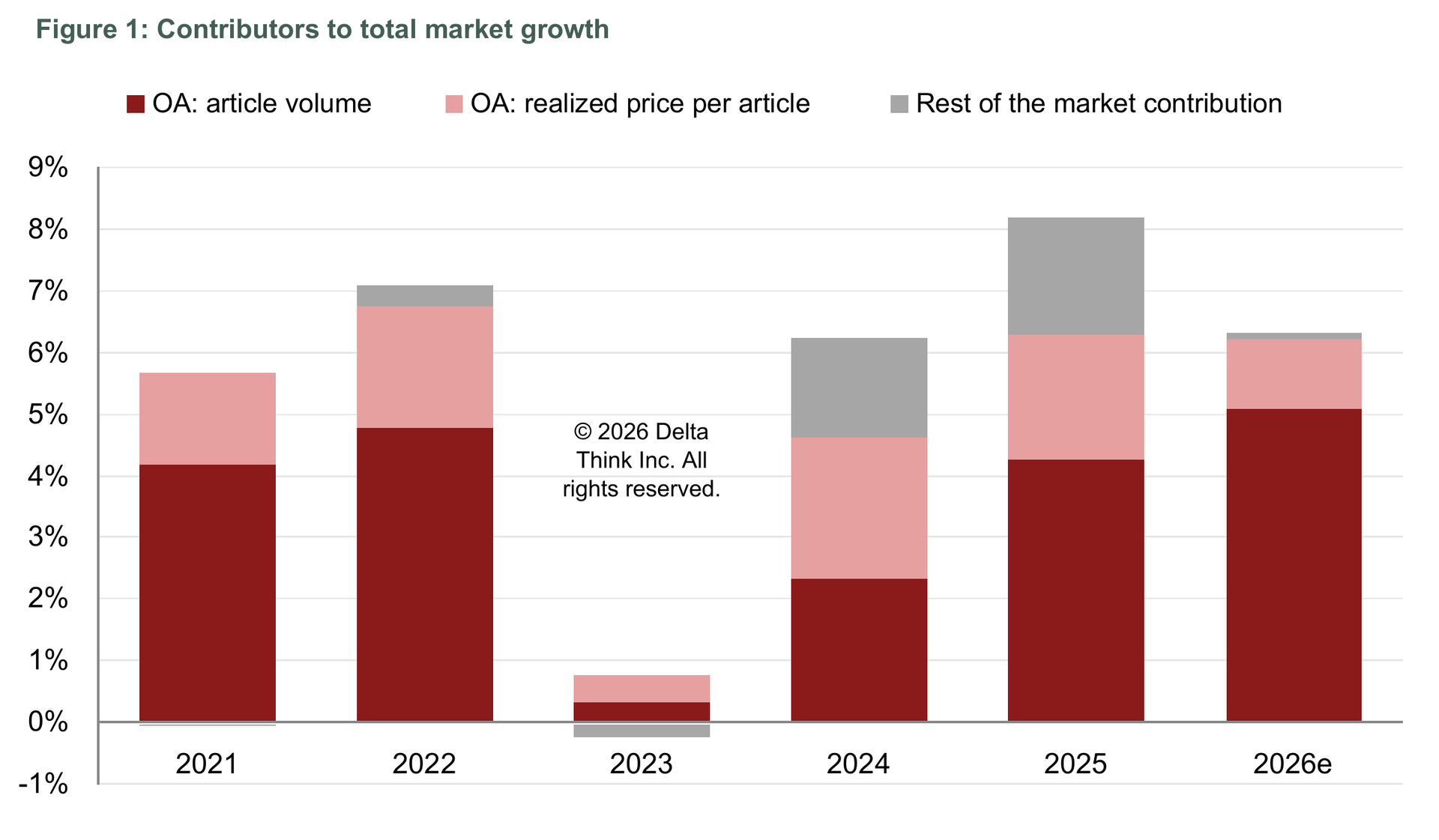


Our estimates show that OA continues growing faster than the overall market and continues to account for a greater share of article volume than revenue. OA is of sufficient scale and share to drive growth in the market overall. The chart splits total market growth into its parts. Growth in OA output drives most of it (dark segments). Rising realized OA prices add more (pale segments). The rest of the market, covering subscriptions, licensing and advertising, contributed little until 2024–25 (it shrank in 2023), when currency and new AI licensing deals lifted it. We expect that lift to fade from 2026.


  • Overall journals market: We estimate the total scholarly journals market grew to just under $10bn in 2025, an outlying increase of just over 8%. The unusually high growth came from OA’s rebound plus one-off lifts from AI licensing deals and currency. We expect growth to fall back quickly to a mid-single-digit pace (2025-28 CAGR (average growth each year) of 5.7%), above the market’s long-term average, as OA continues to carry growth.
  • Open access market: We estimate that the OA market grew to just over $3.4bn in 2025, an increase of just over 20% over the previous year. This represents a return to its historic growth rates and a full recovery from the retrenchment related to special issues.
  • OA share of output and value: 52% of scholarly articles were published as open access, accounting for just over one third of corresponding market value.
  • Fully OA publishers: Large, fully open access publishers saw a significant increase in their article output in 2025 after falling output in the previous two years, as expected. Fully OA’s share of output has returned to its 2022 level, and its share of revenue has exceeded it, driven by both open access and mixed model publishers.
  • Hybrid OA: Hybrid continues its strong growth. Growth in revenue share slowed slightly in 2025, likely because fully OA made up for lost ground. We anticipate it will continue to take share in future. Hybrid usually realizes more revenue per article than fully OA, so as it takes share, it lifts growth.
  • Not OA/Subscription Access: We saw slight (low single-digit) growth in 2025, mainly from licensing revenue. Subscription revenue itself is holding broadly flat in nominal terms, slipping slightly each year, so it is a small drag on total market growth rather than a brake (2025-28 CAGR of +0.2% including licensing).
  • Future outlook: We anticipate that OA publishing growth will continue to outpace the broader journals market. From 2025 to 2028, we anticipate a CAGR of just under 12% in OA output and 15% in OA market value. Both are below long-term averages. As OA takes share, it keeps the total market growing faster than its long-term average.
  • Currency effects: Exchange rates change the growth rates. Without currency effects, the growth rates are lower: OA market value would have grown around 19%, and the overall journals market by 6.8%.


Trends


As we anticipated last year, OA is returning to its long-term patterns of high growth, and growing faster than the overall market, while continuing to generate less revenue per article than subscription access articles. This in turn powers the growth of the total market. Currency effects and new AI deals, on top of OA’s recovery from the special issues retrenchment, caused a spike in total market growth in 2025.


The 2023 plateau was a pause, not a trend


Last year’s data suggested OA’s share of output might have leveled off. With another year of data and better separation of one-off events from underlying trends, it now looks like an interruption. Some of the expansion seen around COVID has persisted, there was not a wholesale falling back to historical growth trends, and OA’s underlying growth trajectory is stronger than it appeared. The two years of decline at large fully OA publishers were specific to those publishers rather than a signal about demand for OA.


The market has moved to a higher growth path


Growth was weak while subscription revenue shrank in the late 2010s. Over the past five years, OA has carried the market to mid-single-digit growth, because OA earns revenue on each new article and OA now commands a sufficient share of output to offset subscriptions shrinkage. We expect that pace to hold, easing slightly as OA’s share of output matures.


Growth in OA drives the bulk of growth in the market


Growth in non-OA output value is broadly flat, so growth in the overall market is tied closely to growth in OA. Where OA fell back, we saw a reduction in total market growth (and a slight boost in non-OA growth). Subscription and other non-OA revenue is holding its nominal value but shrinking in real terms. Transformative (read and publish) agreements play a part. Their fees are often still counted as subscriptions, even as more new articles under them are published OA.


Fundamental drivers of demand for journals publishing remain strong


After disruption of recent years, the underlying trend is up. The fundamental demand for publication services remains. Numbers of researchers continue to grow, and they continue to need publication for validation and career advancement. Governments and funders continue to use publication output and citation density as metrics. Large headline cuts to research funding are localized and have limited effects in a global market of expanding R&D.


AI has the potential to boost demand … with a cost


Many publishers have reported surges in submissions. Growth in output has scaled at roughly half that of growth in submissions. The likely culprit (or driver) is AI. AI boosts both signal and noise. It likely requires a greater level of desk rejects, hence the disparity between growth in submissions and output. However, it is a driver of demand for publication services nonetheless, as well as boosting licensing revenues through new deals. So, AI is a mixed blessing of greater costs of handling poor submissions with greater demand and output. It is too early to say how the AI market will pan out. Deal types and structures are still evolving as are the legal cases underpinning or undermining copyright.


AI licensing revenues


AI licensing is currently a wild card in projections. New deals helped boost growth in 2025. We hold it flat in our projections. If it gains traction, doubling or tripling by 2028, it could add one to two points a year to market growth; if recent deals prove one-offs, it would take about a point off.


Conclusion


We estimate that OA returned to its long-run growth rate, and more strongly than we anticipated a year ago. Fully OA regained its 2022 share of output and exceeded its 2022 share of revenue; hybrid continued to expand; and OA revenue grew by an estimated 20% in 2025. OA’s recovery set the pace for growth in the total market, and licensing and currency gave a one-year lift.


With some distance from the outlying years of COVID and special issues retrenchment, we can now better quantify the longer-term perspective. OA is growing at a multiple of the market growth, supported by both fully OA and hybrid publishing.


The central trend remains: OA accounts for a greater share of article volume than of revenue, but it drives the growth of the overall market. As OA takes share, total market revenue grows increasingly with article output rather than with subscription pricing. OA output grows faster than the market, so growth in OA output lifts market value. Realized OA prices rising at their underlying rates add further growth. Shrinking subscriptions revenues act as a small drag on growth.


Demand for publishing services remains strong. Researcher numbers and papers continue to grow. AI amplifies the demand, but also the cost. Meanwhile, multi-year read and publish deals may serve to lock in some level of stability, but at discounted price points. Driven by OA growth and possibly boosted by increasing AI deals (although it’s too soon to tell for sure), the total market is likely to see higher growth than its historic long-term averages.


As ever, we are very grateful to the organizations that participate in our annual survey, which we anonymize and aggregate to inform our estimates. We will soon send our usual detailed market update and analysis, which breaks out fully OA and hybrid details, to participants.


---


A note about our method


The scholarly journals market is opaque. Analysts must estimate its value by mixing limited observations with modeling. Every year we restate prior estimates as indexing catches up with the previous year’s output. Periodically we also restate when new data or improved methods become available. This year several of these came together at once: richer source data, a redefined market footprint and how we scale our survey to it, and enough distance from the COVID and special-issues anomalies to separate underlying trends from one-off events.


The combined effect is that OA now represents a larger share of a smaller total market, and its recent growth is stronger than we previously estimated. New data mainly changed article counts and the open share of output. Our method mainly changed how we value them.


  • OpenAlex, one of our primary sources, now finds more OA across all years.
  • Better APC information, including from OpenAlex’s journal records, lets us redefine the market around journals that publishers charge for. It also lets us price journals outside our survey sample more precisely.
  • We now estimate the total journals market bottom-up from our own and public data. We previously anchored our estimates to analyst consensus.
  • With enough time now passed since recent disruptions, we can separate lasting trends from one-off events. This lets us refine our modeling and forecasting.


Subscribers can find more information about our methodology changes in the DAT Method section.


---


This article is © 2026 Delta Think, Inc. It is published under a Creative Commons Attribution-NonCommercial 4.0 International License. Please do get in touch if you want to use it in other contexts – we’re usually pretty accommodating.


TOP HEADLINES


DOAJ and Open Access Australasia partner to strengthen open access publishing – November 1, 2026


"The Directory of Open Access Journals (DOAJ) and Open Access Australasia (OAA) have signed a Memorandum of Understanding (MoU) to strengthen trusted, equitable and sustainable open access journal publishing across Australasia."


OMB's Proposed Rule on Federal Grants Rests on Shaky Legal Ground – October 23, 2026


"Two-thirds of the executive orders cited in a rule proposed by the Trump administration on federal grantmaking are still being litigated in court and have, in some cases, been blocked from implementation. If the administration finalizes the rule before the litigation is resolved, these contested orders will be written into binding regulation and remain on the books even if courts strike the orders down."


CRKN Response to New Tri-Agency Open Access Policy on Publications (2026) – October 19, 2026


"CRKN welcomes the recent release of the Tri-Agency Open Access Policy on Publications (2026). CRKN engaged with the Tri-Agency throughout the development of this new policy and we believe that this is an important step towards a sustainable open science ecosystem in Canada."


IReL Publishes OA2030 Report – October 2, 2026


"The Irish Research eLibrary (IReL) today announced the publication of the OA2030: Assessing Pathways to 100% Open Access by 2030 report, a major strategic analysis scoping various pathways to realising a sustainable and inclusive pathway to opening and maximising the impact of Irish research."


OA JOURNAL LAUNCHES


Wiley Accelerates Growth of World-Renowned Advanced Portfolio with Four New Open Access Research Journal Launches – October 27, 2026


"Wiley, a global leader in authoritative content and research intelligence, today announced the launch of four additional new journals in its prestigious Advanced Portfolio, one of the world’s top-tier research journal series. Advanced City, Advanced Food, Advanced Microbiome, and Advanced Psychology have each now begun accepting submissions."



By Lori Carlin & Meg White • October 28, 2026
Extending content reach through different partners, each with a distinct role, value, and tradeoff.
By Lori Carlin & Meg White • September 24, 2026
Understand how rapidly evolving U.S. research policy is affecting your authors and researchers,  and inform what your organization can do in response.
By Lori Carlin & Meg White • August 4, 2026
Publishers will realize the greatest value from AI by approaching it strategically and holistically, aligning business objectives, content assets, and technology to create sustainable competitive advantage. This was the overarching message of the recent webinar, Content to Cash Flow: The AI-Era Monetization Blueprint for Publishers , featuring Christian Kohler (American Diabetes Association), Paul Gerbino (Creative Licensing International), Bonnie Gruber (Delta Think), Uday Majithia (Impelsys), and moderator Barry Bealer (Impelsys), which explored commercialization, licensing, governance, and technology. Watch the full webinar . ICYMI, here’s a peek at what the panel had to say. Key Takeaway #1: Machines are your Newest Audience Perhaps the most fundamental shift discussed during the webinar was about the audience publishers now serve. As Christian Kohler succinctly stated, "We have to start thinking about machines as our readers too." Publishers have previously optimized content for human readers. Today, AI systems increasingly sit between publishers and end users, helping researchers discover literature, supporting clinicians at the point of care, powering educational experiences, and enabling enterprise knowledge management. That changes the requirements for content. AI systems depend on structured information, semantic relationships, clear provenance, and trusted metadata. Publishers who are already ensuring their content is prepared for machine consumption are making it easier to license and making it more valuable to AI-enabled products, services, and workflows. And by not doing so, you may be left behind and replaced by sources that do. We are working with publishers now to prepare their content for machine consumption, making it easier to license and more valuable to use across AI-enabled products, services, and workflows. We can help your organization build the capabilities needed to compete in an AI-first market. Key Takeaway #2: Know the Value of Your Content Before You Monetize It The excitement surrounding AI licensing has prompted many organizations to ask how quickly they can participate. A more important question is whether they understand the strategic value of the content they already own. Bonnie Gruber prompted during the discussion, "Where are you on the AI continuum? Where do you want to be? What value does your content have in your market? That's what you need to understand." Every publisher brings different strengths to the market. Some have highly structured reference content. Others possess unique journals, books, standards, educational resources, images, or proprietary datasets. Those assets will support different AI use cases or command different commercial value. Delta Think helps organizations assess the strengths of their content portfolio and the information needs of their readers so that they are well-positioned to identify the right opportunities, whether through licensing, product innovation, workflow integration, or entirely new business models. Key Takeaway #3: AI Readiness Creates Strategic Flexibility Throughout the discussion, panelists returned to the foundational work that enables long-term success: semantic enrichment, structured metadata, governance, rights management, and knowledge graphs. These investments prepare trusted content to support multiple commercial paths. As Uday Majithia explained, preparing content for AI is about creating reusable, structured knowledge that can power discovery, personalization, workflow integration, and future applications that are still emerging. Publishers cannot predict every business model AI will create. They can, however, prepare their content so they are ready to participate as those opportunities develop. That flexibility may prove to be one of the most valuable outcomes of an AI readiness strategy. Delta Think can work with your team to ensure that your content assets are optimized to support your readers and authors, no matter where the future may lead. Paul Gerbino emphasized, "Licensing is only one possible outcome of becoming AI ready." Moving from Strategy to Execution One of the clearest themes to emerge from the webinar was that AI readiness requires both strategic planning, market intelligence, and technical execution. Publishers need to understand where value exists in their content portfolio, which markets offer the greatest opportunity, and how AI aligns with their long-term business objectives. Simultaneously, they need to prepare content to participate in the next generation of AI-powered products, workflows, and revenue opportunities. That combination is where Delta Think and Impelsys work together. Delta Think helps organizations evaluate market opportunities, content assets, and commercialization strategies. Impelsys provides the technologies that transform trusted content into AI-ready knowledge assets through semantic enrichment, structured content, metadata enhancement, and scalable delivery platforms. The publishers that thrive in the AI era will not be the ones chasing individual licensing deals. They will be the ones that build AI-ready strategies and content assets capable of supporting whatever products, partnerships, and business models emerge next. Ready to start the conversation? Reach out today at info@deltathink.com .
By Dan Pollock & Heather Staines • July 14, 2026
Overview Not all APC markets are created equal. Two journals may charge similar article processing fees yet generate very different levels of revenue. Even closely related disciplines can behave in surprisingly different ways. This month's analysis explores why averages only tell part of the story. Background Our annual APC analysis showed average prices continuing to rise. But averages can hide important differences. Do some disciplines consistently pay more? How much variation exists within a field? And what does that tell us about the underlying market? Average APCs and Value by Subject We can examine the nuances of prices, as shown in the following charts.
By Lori Carlin & Meg White • June 25, 2026
eLearning has been evolving for some time and, like many things, this evolution is being accelerated by AI. As static courses and content repositories shift rapidly into intelligent, personalized learning experiences that target learner needs, integrate into workflows, and deliver measurable outcomes, publishers are determining how to adapt. This evolution represents a significant opportunity for content creators. Organizations possess the trusted content, subject matter expertise, and audience relationships needed to power next-generation learning experiences . The challenge is transforming existing assets into scalable, AI-enabled learning businesses. Evolving Learner Expectations Today’s learners increasingly expect experiences that are dynamic, searchable, interactive, and available within the flow of their work. AI accelerates capabilities for personalization, adaptive learning pathways, assessment, and credentialing. At the same time, publishers and associations face growing pressure to diversify revenue streams, strengthen audience engagement, and demonstrate ongoing value to professional and academic communities . Many organizations possess valuable assets across journals, books, certification programs, conferences, guidelines, and more. However, those assets often remain siloed within discreet platforms, products, and teams. The opportunity is clear. Breaking down those silos once and for all to develop products and services based on user need rather than organizational structure is required to take advantage of the current opportunities. From Static Content to Intelligent Learning AI enables publishers to offer existing content in entirely new ways. Trusted content can now support personalized learning pathways, microlearning modules, conversational interfaces, AI-assisted assessments, real-time recommendations, and skills-based credentialing experiences, creating the opportunity for publishers to increasingly support measurable learning outcomes. Nearly every publisher or professional society owns content and expertise that supports education and learning. Clinical journals, technical references, standards, conference content, guidelines, and scholarly books all provide foundations for AI-enabled learning experiences. Users also increasingly expect seamless, consumer-grade experiences that are mobile, personalized, and data-rich. The instructional value, enabled by the proper technologies enhances skill development and mastery, underpins credential attainment, and supports career advancement. Why Publishers and Societies Are Well Positioned As generative AI expands, trusted content is still the coin of the realm. AI-enabled learning systems require authoritative, domain-specific content to produce reliable, high-quality experiences. Publishers and societies already possess what many technology providers lack: curated expertise, editorial rigor, professional credibility, and established audience trust. This creates a meaningful strategic advantage. Organizations that successfully integrate AI-enabled learning into their portfolios can deepen audience engagement, establish stronger relationships earlier in professional careers, and expand long-term customer and member value . Subscription learning models, certification ecosystems, and continuing education programs can also create more durable and recurring revenue streams. The Strategy and Technology Gap The opportunity to leverage AI in eLearning is significant if your organization is operationally prepared to execute against it. Content may exist across siloed systems. Metadata may not be structured to support adaptive delivery or credentialing. Legacy platforms may lack interoperability, analytics frameworks, personalization capabilities, or scalable AI integration. And then there is the strategy. Organizations must answer broader strategic questions such as: How do we create learning experiences that align with evolving learner expectations and workflows? Which content assets are best positioned for transformation? What business models support sustainable growth? Should capabilities be built, partnered, or acquired? How should AI and eLearning integrate with and support existing publishing and product strategies? Successfully addressing these questions requires strategic alignment and the adoption of fit-for-purpose enabling technology infrastructure. This is where Delta Think, now with the technology power of Impelsys, provides a differentiated and powerful approach. Delta Think has been successfully working with publishers, societies, and information providers to define AI-enabled eLearning strategies aligned to audience needs, market opportunities, monetization models, and long-term goals. Together with Impelsys, we can now go further and provide the technology assessment and foundation needed to operationalize strategy through AI-enabled content delivery, personalization, analytics, interoperability, credentialing workflows, and scalable digital learning platforms. Looking Ahead AI has already begun to redefine what learners expect and what eLearning can deliver. Publishers and societies that move now have an opportunity to transform trusted content into scalable, intelligent learning experiences that deepen engagement, expand revenue opportunities, and strengthen long-term relevance. However, success requires aligning strategy, content, technology, and business models to create sustainable learning ecosystems. Delta Think helps organizations bridge strategy and execution, combining market insight and business planning with the technology infrastructure needed to build and scale next-generation eLearning solutions. Ready to get the conversation started? Reach out today .
By Meg White & Heather Staines • June 16, 2026
Many libraries are discovering that APC management is evolving from operational tracking into institutional analysis of publishing economics to inform strategy development. To date, APC-related workflows have focused primarily on operational needs: processing payments, tracking compliance, or monitoring publishing activity under institutional agreements. However, the questions libraries are being asked now are increasingly financial and strategic: How much are researchers spending to publish? Are institutional agreements producing measurable economic value? In what subject areas are APC costs rising fastest? How do institutional publishing patterns compare with broader market behavior? How can libraries better support authors navigating an increasingly complex journal landscape? Current institutional systems are not designed to answer these questions comprehensively. Publisher dashboards, finance systems, repositories, and bibliometric tools each provide partial visibility, rather than holistic, normalized APC pricing intelligence or longitudinal market context. As a result, many libraries are beginning to combine internal institutional reporting with external market datasets and benchmarking tools. APC Spend Is Becoming a Strategic Institutional Metric APC tracking is often decentralized and incomplete, particularly when payments originate from multiple budgets, departments, grants, or publisher agreements. As OA participation grows and publishing costs and associated models continue to diversify, scaling that approach becomes increasingly difficult. Recent APC market behavior highlights why this analysis matters. While average APCs continue to rise, the more significant trend may be the widening spread of pricing across journal portfolios. In practice, this means institutions can experience meaningful cost increases even when publishing output remains relatively stable. This is driving greater interest in analyses that move beyond aggregate APC totals to examine: Publisher-level APC pricing behavior Subject-specific APC pricing and trends over time Hybrid versus fully OA pricing dynamics Concentration of spend within specific publisher portfolios Longitudinal changes in publishing activity and output Delta Think’s Data & Analytics Tool (DAT) enables libraries to benchmark institutional APC activity against longitudinal market pricing trends across publishers, journals, and disciplines. By normalizing APC pricing data over time, institutions with subscription access to DAT identify cost concentration, track pricing movement, and better understand how local publishing activity compares with broader market behavior. For example, the chart below tracks APC spending and popular price bands from 2019-2026: 
By Dan Pollock & Heather Staines • May 12, 2026
Overview The US National Institutes of Health (NIH) has proposed caps on allowable publication costs, including article publishing charges (APCs) for NIH-funded research. Given the NIH’s scale, how might this policy affect the scholarly publishing market? Could publishers lose revenue? Could funders save costs? What is the potential net economic impact on the research and scholarly ecosystem? Background In summer 2025, the NIH announced an intent to establish new policies limiting allowable publication costs levied against papers arising from NIH-funded research and invited feedback to its proposals. The recently published responses naturally attracted some attention and engagement from a diverse group of stakeholders. The NIH proposed five options, among them disallowing all publication costs, price caps per publication, and limiting publication costs to a fixed percentage of the research grant’s direct costs. The NIH’s proposal cited some research into average publication costs. The analysis looked at journal APCs as listed in the Directory of Open Access Journals (DOAJ), averaging from $1,236 to $2,177. It also analyzed budget requests from its grants, with costs per publication averaging between $2,565 and $3,647. For publishers, these proposals are about more than compliance, it’s about understanding revenue risk, pressure points across portfolios, and where pricing strategies may need to adapt . For libraries, consortia, and funders, it’s about anticipating shifts in spend, benchmarking agreements, and planning for sustainable access models in a constrained environment . Our analysis What effects might the proposals have on total prices paid if implemented? To examine this, we combined data from our Data & Analytics tool with numbers from the NIH’s proposed caps. We also needed to handle a couple of nuances in the NIH’s analysis: The DOAJ lists only fully open access (“gold”) journals. However, under current NIH policy, authors may also publish in hybrid journals 1 . Fully open APCs are typically less expensive than hybrid ones, so we need to include both in our analysis. Quantifying the proposal for a fixed 0.8% of grants’ direct costs presents a challenge as the the figures for these are not published. We estimated the applicable costs by combining figures from NIH reports and statements 2 . Results We took the current APCs multiplied by corresponding volumes of articles as a baseline, allowing for typical discounting that we have observed. We then calculated the change from the baseline for some of the NIH’s proposed options noted above. The results are shown in the chart below.
By Heather Staines • April 20, 2026
We are proud to share a video recording of our March News & Views companion online discussion forum! Each year, this session brings the community together for a data-driven look at article processing charge trends, market dynamics, and what the latest data signals for publishers, societies, funders, and institutions. If APCs factor into your strategy, pricing, or planning for the year ahead, this webinar offers insights grounded in longitudinal data and practical analysis. If you missed the session, or if you attended and would like to watch/listen again, or share forward with friends, please feel free! 
By Lori Carlin & Meg White • April 16, 2026
What happens when the value of your content is extracted, summarized, and delivered via an AI tool … and the audience stops there? As highlighted in The Scholarly Kitchen , this emerging dynamic, known as “the Crocodile Effect,” places AI systems between publishers and their audiences, consuming value while limiting downstream engagement. Recent data underscores the problem and urgency to address it. Publishers across industries – not just scholarly – are seeing dramatic declines in traffic, and AI-driven upstream interfaces, though growing, contribute only a fraction of overall referrals. At the same time, emerging “zero-click” behaviors on search engines, social media, and AI driven platforms are conditioning users to expect answers without leaving the platform. This dynamic is particularly acute in scholarly publishing: highly structured, fact-rich content is uniquely susceptible to being summarized, recombined, and delivered elsewhere. This creates a growing threat to how publishers capture and sustain value from their content through audience engagement. What’s at stake for scholarly publishers The implications go well beyond traffic metrics for scholarly publishers. The traditional model depends on a chain of value: discovery → access → engagement → monetization (via subscriptions, APCs, licensing, advertising, institutional relationships, etc.). AI summaries disrupt that chain at the very first step. When key findings, data points, or interpretations are surfaced directly in AI interfaces: Attribution becomes diluted , weakening brand recognition and authority. Engagement declines , reducing usage along with opportunities for deeper reading, citation, and reuse. Monetization pathways erode , particularly where metrics like cost per download (CPD), impressions, and click through rate (CTR) are used to determine value, collection development, and ad spend. Content integrity risks increase , as summaries may omit nuance, context, or limitations critical in scholarly work. In effect, publishers are providing the foundation for the knowledge economy without benefit, while AI platforms capture increasing portions of the user relationship. What can you do in response? Delta Think partners with publishers to address these issues, focusing on the following strategic areas related to usage and engagement: 1. Reassess what constitutes “value” in your content If core insights can be summarized and consumed elsewhere, publishers must emphasize elements that are harder to replicate. The question shifts from “How do we get clicks?” to “What experiences require coming to us?” 2. Strengthen direct relationships with audiences Invest or partner in channels where there is visibility. Developing strategies that involve your society networks, institutional integrations, and researcher and author workflows allow you to maintain direct engagement with readers and authors. 3. Optimize for visibility within AI ecosystems Conduct research to evaluate how your content is represented and implement recommendations to address problem areas. This includes assessment and development of metadata strategies, structured content, licensing approaches, and partnerships that ensure accurate attribution and appropriate use. 4. Explore new monetization and licensing models Identify the right approaches and determine the right deals for your content, while maintaining overall portfolio integrity. 5. Differentiate through utility and trust Lean into this by establishing your market positioning as an essential destination for validation. Establish your voice based on voice-of-the-customer market research methodologies to ensure your messaging establishes you as the authoritative source for verification, context, and deeper understanding. 6. Monitor and measure emerging referral dynamics Identify and implement new ways of tracking influence, reach, and downstream impact beyond clicks to demonstrate and quantify your value. What’s Next: Work with Delta Think to Turn the AI Threat into an AI Benefit Delta Think has expertise in all the areas outlined above. We ensure organizations develop actionable strategies to address current market changes and dynamics. The rise of AI-mediated discovery and zero-click experiences is an active and accelerating shift that requires evidence-based decision-making today. This is where Delta Think thrives. Our expert insights provide publishers with the data needed to understand where their exposure to AI-driven disintermediation is greatest, how usage patterns are evolving across channels, and which strategic responses are most likely to drive sustainable value. This includes identifying where traffic loss is most acute, where new forms of engagement are emerging, and how content, data, and licensing strategies must adapt in response. Delta Think can guide you in the development of a successful strategy that ensures the sustainability of your publishing program. Lori Carlin and Heather Staines will be attending the upcoming STM Annual Conference (April 22-23, Washington, DC) and SSP Annual Meeting (May 27-29, Chula Vista, CA), and Heather will be at the 2026 CSE Meeting (May 3-5, Durham, NC), so please reach out to set up a check in and continue the conversation. Not traveling this spring? We are always available at info@deltathink.com .
By Dan Pollock & Heather Staines • April 7, 2026
This month we examine our latest data about Article Processing Charges (APCs). Per article pricing is a fundamental building block for all paid publishing models, so our review provides an invaluable insight into how the cost of open access continues to evolve. APC prices in general continue to increase, but at a slower rate compared with this time last year. Important nuances in the distribution of prices continue to affect the value and cost of paid publishing models. Background Each year we survey the list price Article Processing Charges of a sample of more than 40 scholarly publishers. Our dataset covers more than 20,000 titles dating back to 2016 and represents one of the most comprehensive reviews of open access pricing. To compare like for like, we consistently analyze non-discounted, CC BY APCs. We take a snapshot annually in January, so we can track yearly changes while controlling for publisher price changes throughout the calendar year. Our statistics here exclude zero or unspecified APCs, although these are present in our underlying data (and available to our subscribers). This allows us to capture trends where publishers choose to charge APCs without skewing averages. We run separate analyses around APC-free models. Headline Changes Going into 2026, we see APC prices increasing, but the percentage increases continue to fall back to track long-term trends. Fully OA APC list prices across our sample have risen by around 6.8% compared with 6.4% this time last year. Hybrid APC list prices have risen by an average of 5.3% compared with 3% this time last year. Maximum APCs for fully OA journals remain at $8,900. Maximum APCs for hybrid journals now top out at $12,850 (up $160 from last year). Average APC prices have increased more this year than last year. However, the increases remain lower than the highs of a couple of years ago. Underlying trends continue. Average APC price increases are getting larger each year. There are approximately 2.4x more hybrid journals than fully OA ones, down from 2.6x last year, and 2.9x a year before that. The proportion of journals that are hybrid is slowly falling. However, because they are the majority, hybrid journals follow (or, rather, set) a similar pattern to the market overall. On average, fully OA prices are around 67% of those of hybrids – consistent with long-term trends. Around 24% of our sample of fully OA journals charge no APCs, compared with 22% last year. (We have separately analyzed the number of articles in OA journals.) Price increases vary significantly by discipline. Fully OA Arts and Humanities journals saw larger than average increases; Multidisciplinary journals saw lower than average increases. Price Distribution Market-wide headline price changes mask important nuances. We have discussed previously that the most important nuance lies in the spread of prices within a given publisher’s portfolio. For example, if the bulk of a publisher’s journals lie towards the lower end of its APC pricing, with just a few journals priced at the higher end, the average (mean) price will be higher than most authors pay. The following figures show how the spread of APC prices plays out in the market across our sample of publishers. The figures are outlines of histograms, showing how many titles sit in various price bands over the successive years of data we have curated. The red line shows the most recent year’s prices. The lines become more green as they go further back in time. Subscribers to Delta Think’s Data & Analytics Tool can see full details of the Number of Titles and Price Band axes. Hybrid Prices The spread of price bands for hybrid journals is shown in Figure 1 below.