News & Views Supplement: Defining Open Access
Dan Pollock and Ann Michael • June 1, 2020

Analyzing any data about open access uptake – and by implication what’s not OA – can fall foul of different definitions and interpretations. In common with major indexes, we use data from Unpaywall to help us understand the access models in use across the literature. Here we unpick the definitions and color-coding in use (such as Gold and Bronze) so we can clarify the parameters of our market analysis. This discussion was originally posted as a companion to our preliminary 2020 OA uptake analysis, but supports terms used throughout our Open Access Data and Analytics Tool (OADAT).


What's in a name


The formal definition of Open Access was coined by the Budapest Open Access Initiative in 2002, which defines it as [scholarly] research literature's free availability on the public internet “without financial, legal, or technical barriers other than those inseparable from gaining access to the internet itself. The only constraint on reproduction and distribution, and the only role for copyright in this domain, should be to give authors control over the integrity of their work and the right to be properly acknowledged and cited.” This is roughly equivalent to the Creative Commons Attribution (CC BY) license.


The combination of free of charge to read AND of permissive usage rights form the essence of the formal definition of Open Access. However, the contemporary use1 of “open access” can also cover just the “free of charge to read” subset of the formal definition, excluding permissive usage rights beyond fair use or similar.


More than mere pedantry


As we have discussed previously, we use data from Unpaywall2 to analyze per-article information about Open Access. The other major indexes (such as Web of Science, Scopus, and Dimensions) also use this data too.


In their paper3 examining OA uptake from an early data set, the Unpaywall team explore various definitions of open access. They state their use of open access to mean “free to read online, either on the publisher website or in an OA repository.” Given their aim to direct researchers to legitimately “open to read” articles, this definition is understandable. However, as it underpins their algorithms, and we need to take a different approach to fully analyze the market, we need to unpick it. Table 1 shows how Unpaywall classifies OA.


Table 1: OA status - Unpaywall detection model


The table below summarizes how Unpaywall sets its article OA status indicator.

The table separates the article types (rows) from the journal types (columns). The algorithm checks articles in a series of steps to determine their OA status. Note the use of colors to identify status and – as explained below – how licenses may not always be analyzed.

  • Unpaywall’s definition of “open access” covers anything that is “open to read”, as highlighted in the heavy outline.
  • Green: “Toll-access on the publisher page, but there is a free copy in an OA repository.” This would therefore exclude papers which are embargoed and not deposited in repositories (“Delayed OA”). This is an important subset, as papers would be affected under the zero-embargo rules such as those put forward by Plan S. The license is not checked, so “green” papers may not have permissive reuse terms.
  • Gold: “Published in an open-access journal that is indexed by the DOAJ [or in its own its own list of journals and fully OA publishers].” If the article is in such a journal, the license is not checked. For our purposes we assume a permissive license.
  • Hybrid: “Free under an open license in a toll-access journal”. Technically, this is any journal which is NOT identified as being in the fully OA list used for the Gold status. This will include hybrid journals, which offer authors a choice of open access options. However, it also includes fully closed journals, which do not offer authors a choice, but in which the publisher may occasionally and unilaterally choose to make content open access. The licenses span various CC licenses, and others; we assume they offer fully permissive reuse rights.
  • Bronze: “Free to read on the publisher page, but without a clearly identifiable [open] license.” “Bronze” is a term that appears to have been coined by Unpaywall – it most closely corresponds to public access, such as that currently required by the US OSTP. As with hybrid, this will mix genuinely hybrid journals with fully closed ones which make selected content free to read.
  • Closed: “All other articles, including those shared only on an ASN [Academic Sharing Networks, such as ResearchGate and Academia.edu] or in Sci-Hub.” Technically, legitimate access to an article is the first thing the Unpaywall algorithm looks for when classifying articles. If none is found, the article is considered closed. This means articles made open by ignoring copyright (“Black OA”) are ignored.


This gives a reasonable view of “open to read” articles. By focusing in on the “gold” and “hybrid” subset we can get to formally “Open Access” articles which include permissive reuse rights. However, as journals in this model are classed as either “fully OA” or “not” there is no separation of hybrid journals. So understanding hybrid take-up is not possible without further analysis.


Formally "Open Access" and Hybrid


To get to uptake of OA in hybrid journals, we need to separate out the journals that offer no OA options. We infer this from Delta Think’s own lists, which cover 70% of the articles indexed by Unpaywall since 2015. We can also look for patterns in Unpaywall data and make some intelligent guesses about the unknowns – e.g. we can infer a journal has no OA options if there is no OA output in it at all. We also have to correct errors in the fully OA journals. Unpaywall does a good job against a complex data set, but still we found cases where articles in supposedly fully OA journals that were classified as “hybrid” and vice versa.

The 12 combinations of article type and journal type mean we have to take decisions about how we categorise articles. Table 2, below, shows how our analysis adds formal Open Access classifications to the raw Unpaywall data.


Table 2: Open Access = free to read and free to reuse
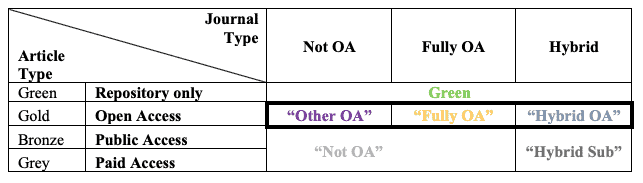
The table separates the article types (rows) from the journal types (columns). It further splits “not fully OA” journals into “Not OA” journals (those with no OA options) from Hybrid journals.

  • The bolded box shows “formal open access” to cover only openly readable articles with OA licenses.
  • We can now add descriptive names to our Article Types (2nd column).
  • The same caveats for fully OA journals apply as before. If a journal is fully OA in our lists, we assume its contents to be permissively licensed. We have not checked license information within the Unpaywall data.
  • For Hybrid journals, any articles not under an OA license (as checked by Unpaywall) are deemed to be part of the journals’ subscription content.
  • Finally, there is a third bucket of OA content: OA articles in journals without an advertised OA option. These form a small but notable subset of output – e.g. 1 or 2% of some big-name journals.


Note that our method is not fail proof. Where we cannot identify a journal from a publisher’s price list, we infer its type based on its articles. Where Unpaywall cannot (or has not) identified open licenses, we assume a journal is not OA. We have seen examples of journals which promote themselves as “open access” but do not explicitly specify licenses for their content. In this case a journal would be classified as Not OA.


"Public Access" = free to read


There are some anomalies in the data in the real world. For example, technically, there should be no “Bronze” articles (articles without an OA license) in fully OA journals; in practice we have found some in the data. Formal OA definitions only apply to peer-reviewed content, however the Unpaywall/Crossref data also includes non-peer -reviewed content. It requires further analysis to separate the two. When we apply our corrections, we need to form a view on where to classify the free to read articles. This is shown in Table 3.


Table 3: Public Access Status
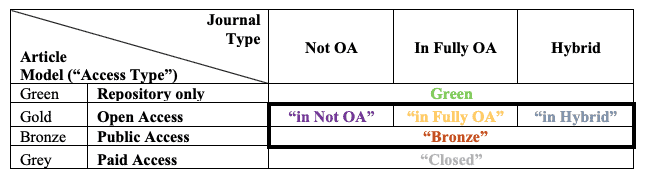
Again, the table splits article types and journal types, but this time with a focus on articles that are “open to read” without regard to their licenses.

  • Unpaywall coined the term “Bronze” to refer to articles not in fully OA journals that are free to read but without a verifiable OA license. We extend Bronze here to cover articles in any type of journal that are free to read but without a verifiable OA license.
  • This is important for understanding possible impacts on subscriptions. The more that’s free to read, the more downward pricing pressure on subscriptions. Our underlying data allows the separation of Bronze be journal type, so users of the OA DAT can further analyze free to read content in journals with subscription components.
  • The “in Fully OA” & “in Hybrid” numbers look at output “that might reasonably have an APC.”


Conclusion


For our analysis, we take “Open Access” to mean that articles can be read both free of charge and free of major restrictions on reuse. We use “Public Access” to refer to articles which are available free of charge, but which have restrictions on reuse.

Other sources may use “open access” to span both definitions as suits their purpose. We advise that readers seek clarity about which definitions are being used when interpreting data.


The role of licenses is crucial in a market context. APCs may vary depending on license type, and funder OA mandates may insist on permissive reuse rights. So we further distinguish “Repository only” for articles not available from publisher’s web sites, and “Paid access” for the paywalled ones. Together our four definitions span what we might term an article’s “Access Type.”


Finally, journals are core to publishing activities and economics. Initiatives such as Plan S take a position on parent journals as well. Our orthogonal “Journal Types” consider the major journal business models, so we can develop a full analysis.


1 Suber P. (Aug 2008) Gratis and libre open access. SPARC Open Access Newsletter, 124. http://nrs.harvard.edu/urn-3:HUL.InstRepos:4322580

2 “Unpaywall is an open source application that links every research article that has been assigned a Crossref DOI (more than 100 million in total) to the OA URLs where the paper can be read for free. It is built and maintained by Our Research (formerly Impactstory), a US-based nonprofit organization.” – The Future of OA: A large-scale analysis projecting Open Access publication and readership. Piwowar, Priem, Orr. Oct 2019. https://doi.org/10.1101/795310.

3 Piwowar, Priem, et al. (Feb 2018) The state of OA: a large-scale analysis of the prevalence and impact of Open Access articles. PeerJ. https://doi.org/10.7717/peerj.4375.

By Lori Carlin December 4, 2025
Impelsys and Delta Think Join Forces to Expand Strategy and Technology Capabilities for Publishing, Scholarly Communications, Education, and Healthcare Communities
By Dan Pollock and Heather Staines December 2, 2025
Overview Each year, our scholarly market sizing update and analysis goes way beyond open access headlines. One consistent finding is that market share of open and subscription access is highly dependent on subject area. This month we look at how to best use our Delta Think Data and Analytics Tool (DAT) to understand and analyze these variations. With coverage of approximately 220 detailed subject areas, the data shows that headlines can sometimes mask important detail. Background Since we began our scholarly journal market analyses in 2017, one of our core objectives has been to enable deep analysis of our headline findings. Our annual market share updates represent a summing of data – more than 200 detailed subject areas, 200 or so countries, also split by society vs. non-society journal ownership. This level of detail is clearly too much for our monthly short-form analyses, so we present the market-wide headlines in our annual updates. However, by picking one subject area as an example, we can see how much nuance lies beneath the surface, and why these variations matter. Subscribers to DAT can use our interactive tools to quickly and easily see each level of detail and filter for just those relevant to their organization. Market Share Variation by Subject Area Our latest market headlines suggested that open access (OA) accounted for just under 50% of article output in 2024. However, this headline proportion varies considerably by subject area.
By Lori Carlin & Meg White November 19, 2025
Navigating Uncertainty, Innovation, and the Winds of Change As the Charleston Conference 2025 wrapped up, one thing was clear: scholarly communication continues to evolve against a backdrop of uncertainty: economic, technological, and policy-driven. Yet amid the turbulence, conversations throughout the week pointed toward resilience, adaptability, and even optimism. As Tony Hobbs observed during the Shifting Tides policy session, “the good news for scholarly communication is that due to technology advances, it is now possible to sail into the wind.” The Elephant in the Room: Doing More with Less Heather Staines Every conversation I had in Charleston seemed to circle back to one thing: budgetary uncertainty. Whether the concern was policy changes like potential caps on overhead or shifting grant funding or the ripple effects of declining enrollment, both domestic and international, everyone was asking how to do more with fewer resources. This theme ran through the plenary Leading in a Time of Crisis, Reclaiming the Library Narrative, and even the lightning sessions, a shared recognition that we’re all trying to redefine what “enough” looks like. What stood out was how data-driven decision-making has become essential. Libraries, publishers, and service providers are not just analyzing what to add, but what to let go of, all in an effort to find a new balance. And then there’s AI. We have moved beyond “sessions about AI” to “AI everywhere.” I will admit that I once thought AI was a solution in search of a problem, but now it’s woven through nearly every conversation. Librarians are leading the way on AI literacy, while publishers and service providers are using AI to innovate to meet changing research needs. The uncertainty is real but so is the shared determination to adapt, learn, and move forward together. The Long Arm of the Law and Its Reach into Scholarly Communication Meg White One of the things I love about Charleston is that there is always a moment that challenges me to reframe how I think about the work we do. This year’s Long Arm of the Law session did exactly that. It was a vivid reminder that the legal and policy currents swirling around us are not abstractions; they shape our ecosystem in ways we can’t afford to ignore. Paul Rosenzweig set the stage with a fascinating and lively walk through the history of executive orders. Hearing that Washington issued just eight while later presidents relied on them more frequently primarily to advance political agendas made the evolution very real. What stood out was the fine line between legitimate executive authority and overreach, and how easily those boundaries can blur. Nancy Weiss then brought the conversation directly into our lane with her analysis of an Executive Order directing the Institute of Museum and Library Services (IMLS) to reduce its activities to the bare legal minimum. Her experience as former General Counsel gave us an inside view of what such a directive could mean for libraries, museums, and cultural programs, all places where so much of our community’s work takes root. Sessions like this are why Charleston continues to be invaluable to me. They stretch my understanding, give me new context, and remind me that staying informed is part of how we navigate change together. Data-Driven Insights: The 2025 Author and Researcher Survey Lori Carlin My week was cut unusually short (for me) by other meetings I had to fly off to, but I still managed to squeeze in 2.5 days of interesting sessions, discussions, and ‘business casual’ gatherings. The first two events I attended this year were definite highlights, both of which were the brainchild of and brilliantly orchestrated by my colleague, Heather Staines – the Vendor Meetup on Monday evening and the Leadership Breakfast on Tuesday morning. Both were jam packed and filled with lively conversation. If you’re not familiar, the Vendor Meetup is an open, casual gathering (sponsored this year by Get FTR) designed to give vendor representatives, especially early career attendees, who attend only for Vendor Day a chance to socialize and network, something they often miss when they’re in and out in a single day, but all are welcome to attend! The Leadership Breakfast, a smaller invitation-only event designed to give a more intimate networking experience within the larger Charleston Conference, is always a thoughtful session centered on a pressing issue of the day, and this year was no exception. The discussion focused on sustainability across the entire scholarly communication ecosystem—from funders to libraries to publishers. Frankly, no one can unhear the words of one of the panelists (a library director) when he commented that his budget has dropped from ~$7M to ~$5.4M in the last 24 months … with more to come. Finally, I’m a little biased, but I dare say I and my panelists were very pleased with the session I moderated focused on the impact of US research funding changes, which highlighted info from Delta Think’s Spring 2025 Author and Researcher Survey, along with how publishers who participated used the data to inform their strategies. We also had a librarian on the panel who informed the audience about the impact of these changes on universities overall and libraries in particular. As you may know, the survey data showed rising concern about institutional support, with many researchers rethinking how they publish and participate in conferences. Respondents also described how tightening budgets are straining peer review and research dissemination, while responses varied sharply between U.S.-based and international authors, reflecting distinct policy and institutional pressures, it also showed that the impact is being felt globally. In the tradition of Charleston, what made the session so powerful was the discussion. Colleagues from societies, publishers, and libraries focused on how they are using these insights to understand the challenges and to act on them. From adjusting publishing strategies to helping researchers to growing relationships in other markets, to shaping advocacy and outreach activities, organizations are using these insights to inform resource and budget direction in innovative ways. For me, that was the real takeaway: turning evidence into collaboration, and progress. Even in uncertain times. We’re running the survey again now with plans to compare results to the Spring version. If you’re interested, there is still time to sign up! End of An Era (Two, in Fact!) This year’s conference marked a pivotal moment: the first without the in-person presence of founder, Katina Strauch (though we were grateful for her virtual participation), and the well-earned retirement of longtime Conference Director Anthony Watkinson, who rang his iconic bell one last time. We would not be here without them and their visionary colleagues who built this community from the ground up. Thank you, Katina and Anthony. Charting What Comes Next If there was one metaphor that captured Charleston 2025, it was motion; not adrift, but deliberate progress in the face of resistance. From policy updates to AI integration to the enduring strength of the scholarly community, the week’s sessions affirmed that innovation often takes root during uncertainty. As Tony Hobbs reminded us, even headwinds can propel us forward — if we learn how to adjust our sails.
By Heather Staines November 6, 2025
We are proud to share a video recording of our October News & Views companion online discussion forum! Join us for our annual update on the volume and revenue associated with Open Access publishing. If you missed the session, or if you attended and would like to watch/listen again, or share forward with friends, please feel free!
By Dan Pollock and Heather Staines October 21, 2025
Overview After a rocky couple of years, the open access (OA) market may be finding its footing again. Each year, Delta Think's Market Sizing analyzes the value of the OA scholarly journals market—that is, the revenue generated by providers or the costs incurred by buyers of content. Our analysis estimates that the OA segment expanded to just under $2.4bn in 2024. Although growth has improved compared with last year’s deceleration, it continues to lag behind the broader historical trend for OA. The proportion of articles published as OA has declined slightly, likely driven by continued reduction in the output from the large OA publishers. This trend has benefited established publishers, who saw growth in OA activity and revenue as they continued to consolidate their positions. Looking ahead, OA could soon begin outpacing the broader journals market once again—but likely through different growth drivers than in the past. Read on to see what those shifts might look like. Headline findings Our models suggest the following headlines for the 2024 open access market:
By Lori Carlin & Meg White October 13, 2025
Collaborate with Delta Think to uncover how funding and policy uncertainty continue to reshape the research ecosystem — and gain tailored insights for your community.
By Lori Carlin & Meg White September 25, 2025
Introduction: One question, two paths  A recent essay in The Conversation posed the question, “Is ChatGPT making us stupid?” The author examined emerging research suggesting that over-reliance on AI tools for writing can dull critical thinking, originality, and even memory retention. But as the author points out, AI has the potential to augment human intelligence when used well , acting as a catalyst for deeper thinking rather than a shortcut around it. We agree and seek to guide our clients in determining how to use AI to strengthen research and scholarship. From concern to opportunity When AI is approached as a collaborator, it sparks creativity, deepens inquiry, accelerates problem-solving, and amplifies creativity. It can strengthen teams, enhance services, and improve efficiencies across the publishing enterprise. Turning Ideas into Action Here’s how Delta Think can help you transform smart AI potential into purposeful, strategic action: Strategy and Market Research Focus: Identify where AI can deliver the most value for your organization, grounded in community needs and behaviors. Delta Think Approach: Gather and analyze evidence through quantitative and qualitative methods to uncover how your community – your researchers, authors, reviewers, and readers – are using AI now or, better yet, where and how they could be using it in the future. Marrying their unmet needs with your strategic goals creates your roadmap to future success. 2. Build vs. Buy Decisions for AI-Powered Products Focus: Develop proprietary AI solutions, partner with trusted vendors, or combine the best of both approaches to suit your needs. Delta Think Approach: Assess your current state and future needs, design decision frameworks that weigh cost, capability, risk, speed-to-market, and long-term scalability, and build the approach that will work best to support your business goals and community needs. 3. AI Policy and Governance Focus: Ensure responsible, transparent, and ethical AI use that safeguards scholarly integrity. Delta Think Approach: Facilitate the development of your AI governance with the creation of important guardrails and policies, working to mitigate bias and hallucination risks, safeguarding research integrity while enabling innovation. 4. UX/UI Testing for AI Products and Features Focus: Design AI experiences that enhance human engagement. Delta Think Approach: Test results, interfaces, prompts, and transparency signals to keep users informed, empowered, and confident in your products and tools. 5. Licensing and Partnership Strategy Focus: Leverage commercial arrangements to unlock AI potential while aligning with your mission and values. Delta Think Approach: Guide you through licensing agreements, proprietary data partnerships, and collaborations that create sustainable competitive advantage and strategic revenue streams. Turning Ideas into Impact By reframing the conversation from Can AI substitute scholarship? to How does AI amplify scholarship? , publishers can lead the next wave of innovation. Delta Think’s collaborative approach ensures that your organization’s adoption of AI enhances creativity, critical thinking, and trust. We can help you map out your bespoke AI-strategy roadmap, develop new products and services, test prototypes, and design governance guidelines. Reach out today or schedule some time at the Frankfurt Book Fair (10/14-16) to discuss how Delta Think’s expertise and proven methodologies can help your organization unlock key insights and drive innovation.
By Dan Pollock and Heather Staines September 9, 2025
How might planned cuts to funding of the US National Science Foundation affect scholarly output? In our last News & Views we analyzed how the headline cuts might apply to relevant activities. This month we examine how journals may be impacted and model some scenarios quantifying the impact on global scholarly output. Background The US National Science Foundation is an independent US federal agency that supports science and engineering across the US and its territories. In its 2024 financial year (FY) 1 , it spent around $9.4 billion, funding approximately 25% of all federally supported research conducted by US colleges and universities. In July we looked at how reported funding cuts and NSF budget cuts proposed by the US Government might affect the NSF’s output of research papers. We found that in the near term the effects would be limited, as the cuts focus on NSF activites that produce low volumes of papers. However, cuts proposed over the coming year may have a more profound effect as they are deep and affect research activities. We have also previously analyzed proposed cuts to funding of the National Institutes of Health (NIH). We noted how cuts to the world’s largest producer of biomedical research could have a profound effect on publication outputs. So how do cuts to the NSF stack up? The effects on journals As ever, the headlines and averages are unevenly distributed, so we looked at how individual journals might be affected. 
By Dan Pollock & Heather Staines July 29, 2025
The US Government has planned cuts to funding of the US National Science Foundation (NSF) in 2025 and 2026. Before we can undertake a full analysis of how these cuts might affect publishers, we must unpack some data. This month we put the cuts in context, looking at how the cuts impact research and the scale of NSF output. And we find they may not affect research in the ways the headlines suggest. We will follow up with a future analysis modelling specific scenarios of impacts on publisher submissions. Background The US National Science Foundation is an independent US federal agency that supports science and engineering across the US and its territories. In its 2024 financial year (FY) 1 , it spent around $9.4 billion, funding approximately 25% of all federally supported research conducted by US colleges and universities. In May 2025, the New York Times (NYT) published an article analyzing proposed cuts to NSF funding by the current US Government. The NYT’s analysis suggested a 51% cut in funding from 1 January through 21 May 2025, with a further 56% reduction proposed for next year 2 . We have previously analyzed effects of proposed cuts to funding of the National Institutes of Health (NIH). The proposed cuts to the NSF are deeper, so might they have an even greater negative effect on publication volumes? Understanding what the cuts apply to The 51% cut in 2025 covers 140 days, equivalent to a 20% annualized cut. So could we see the same level of reduction in papers this year? And could this be followed be a 56% drop next year, as the 2026 cuts cover a full year? As with our analysis of the NIH, we need to understand how the changes in funding translate into research activities, and thence into corresponding volumes and timing of publication output. We therefore analyzed the NSF’s own budgetary figures to put the cuts into context. 
By Lori Carlin and Meg White July 24, 2025
This spring, Delta Think collaborated with 27 professional societies and associations to launch a Global Author/Researcher Survey to understand the ripple effect of US government research funding cuts. Our goal was to explore how researchers are navigating a rapidly evolving landscape, especially as US federal funding and policy decisions cast long shadows over the global research community.  More than 13,000 researchers across every major discipline and 135 countries shared their voices through our survey. While the detailed findings are deep and wide-ranging, one thing is clear: the ground is shifting. Uncertainty Is Driving Change in Research Behavior Delta Think deeply analyzed the data by six major disciplines: Health Sciences, Life Sciences, Physical Sciences, Engineering & Technology, Social Sciences, Arts & Humanities. Nuances vary by each main field, but some factors were universal. US-based researchers are signaling deep concern – and they’re bracing for change. Many anticipate reductions across publishing output, participation in peer review, and conference attendance. For example, 62% of US authors across all disciplines expect to publish fewer articles in the next 1–2 years, citing policy and funding challenges . “My research progress is now in ‘conservative mode’ in case funding is pulled from us with no notice. We cannot plan further out and have lost our trust in the federal government.” Primary Investigator (PI) at a US Academic Medical Center But the concerning news isn’t limited to the US. International researchers indicated their intention to pull away from US-based journals, threatening to reshape the global flow of research. In fact, a full 50% of international authors across all disciplines indicated that it is now important to them to submit their manuscripts to non-US journals. “We're doing everything we can to reduce our connections to the US, including looking for journals to publish in that are not based in the US.” Mid-Career PI, Biological Sciences, Canada Top Concerns: What Keeps Researchers Up at Night? One of the clearest patterns that emerged is the contrast in what researchers view as their most urgent challenges: For US researchers , the top concern is straightforward: elimination of research funding . This fear extends beyond specific grants—it reflects a deep anxiety about career stability, institutional viability, and the future of scientific advancement. For international researchers , the primary worry is academic freedom and collaboration , with many expressing concerns about losing access to US research infrastructure, data, and professional networks if international cooperation is reduced. While these represent the top concerns, the survey results reveal many others by discipline, career stage, and other factors, including specific community details for each of the 27 participating societies and organizations upon which to develop their future strategies. Looking Ahead: Tracking Trends with Fall 2025 Survey This spring’s survey was just the beginning. Delta Think will conduct a follow-up survey in October/November 2025 to track how attitudes and behaviors continue to shift. This next phase will allow us and the participating organizations to move from snapshot to trend — providing deeper insight into the lasting impact of funding and policy uncertainty. Joining in for Survey 2 is NOT limited to Survey 1 participating organizations. All are welcome to participate in this next round and have access to the deep data behind these high-level insights and much more. Turning Ideas into Action The Delta Think team designed this initiative not just to gather data, but also to support our partners across the scholarly ecosystem. By combining rigorous research design with deep industry context, we’re helping publishers, societies, and institutions make informed, strategic decisions in uncertain times. If you're interested in learning more about the findings, discussing how they apply to your organization, or joining the Fall 2025 survey, we’d love to connect. Please email Lori Carlin to start the conversation.